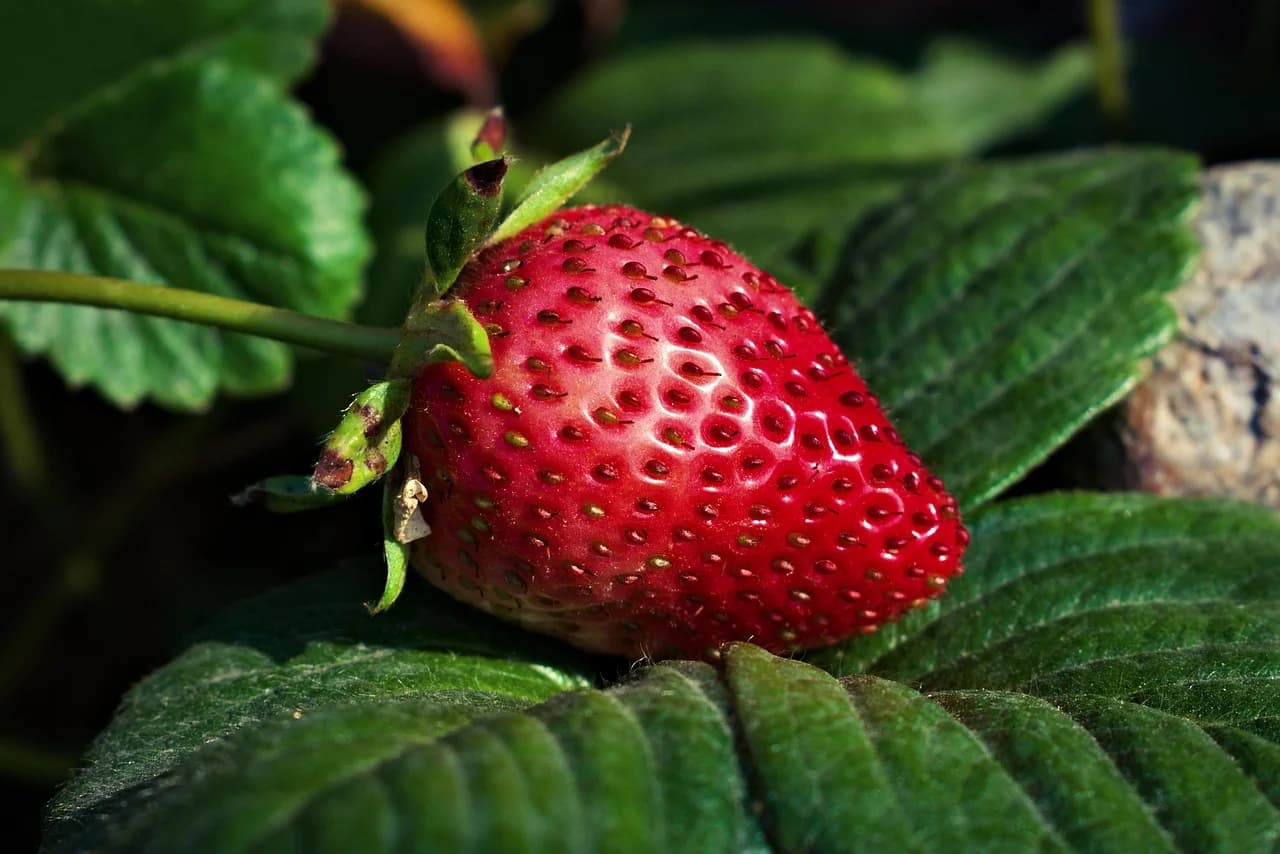
Strawberry
Fragaria × ananassa
A low-growing perennial fruit that's usually started from plants or runners, not seed. Grow it in sun in beds, pots or baskets; raising it from seed is possible but slow.
Quick facts
- Germination time
- 14–21 days
- Germination temperature
- 16–24 °C61–75 °F
- Sowing depth
- Not yet verified
- Spacing between plants
- Not yet verified
- Days to maturity
- Not yet verified
- Sun
- Full sun, partial shade
Non-toxic to cats and dogs
By SeedBattle EditorsUpdated
Spotted a mistake or missing detail? Improve this page
01 · Overview
About strawberry
Garden strawberries (Fragaria × ananassa) are low-growing perennials in the rose family, grown for their sweet red fruit. The plants grow 6 to 12 inches (15–30 cm) high and 1 to 2 feet (30–61 cm) wide. Gardening experts describe three main types: summer-fruiting strawberries, with one short, heavy crop; perpetual (everbearing) strawberries, which fruit in smaller flushes from early summer to early autumn; and alpine strawberries (Fragaria vesca), with small, aromatic berries. In the US, June-bearing varieties, which fruit in May and June, are the most common, and day-neutral varieties flower over a longer season.
Seeds or plants? Most strawberries are grown from plants, not seed. Summer-fruiting and perpetual strawberries are grown from runners or young plants, while alpine strawberries can also be grown from seed. Some day-neutral hybrid garden strawberries are sold as seed too, but growing strawberries from seed takes patience.
Growing details
- Start indoors
- Not yet verified
- Sow outdoors
- Not yet verified
- Water
- Not yet verified
- Containers
- Yes
- Height
- 15–30 cm6–12 in
- Spread
- 30–61 cm1–2 ft
- Frost tolerance
- Hardy
- Soil pH
- pH 6.0–6.5
- Life cycle
- Perennial
- Hardiness zones
- Not yet verified
02 · How to grow
How to grow strawberry from seed
Starting with plants (the usual way). Plant in spring, late summer or early autumn. Planting in August or September gives plants time to settle in before they fruit the following year. In Maryland, bare-root starter plants go out in March or early April, as the soil begins to warm. Planting depth matters: if the crown is buried too deep it rots, and if it sits too high the plant dries out quickly. Gardening experts space plants 35–40 cm (14–16 in) apart in rows about 75 cm (30 in) apart.
Starting from seed. Expect a slow start. The seeds first need about a month in the refrigerator (stratification) to break dormancy. Then they can be germinated and grown indoors for 6–8 weeks before going into the garden. Gardening experts sow thinly, pressing the seeds into a moist soilless mix, keeps the soil at 60–75 °F (16–24 °C) if possible, and notes that seedlings can take 2–3 weeks to emerge. For alpine strawberries, gardening experts sow in spring or autumn and lightly covers the seeds with sharp sand. They germinate at about 18 °C (64 °F), though germination can be slow and patchy, and the plants often fruit in their first year.
Site and soil. Strawberries grow best, and produce their sweetest fruit, in a sheltered spot in full sun, though they tolerate some shade. They like fertile, well-drained, slightly acidic soil; gardening experts recommend a sandy loam with a pH between 6.0 and 6.5. If your soil drains slowly, build a raised bed at least 12 inches (30 cm) high. Avoid spots prone to late frosts, which can damage the flowers.
Pots and baskets. Strawberries grow well in pots, growing bags, hanging baskets, troughs and tubs. Plant with the crown level with the compost surface, about 20 cm (8 in) apart, put the container in a sheltered, sunny spot, and water regularly. Containers also keep soil diseases from building up, and the fruit is less likely to be eaten by slugs.
03 · Care
Caring for strawberry
Watering. Strawberries have short roots, so they need frequent watering: about 1 to 1½ inches (2.5–4 cm) of water a week during key growth stages. Water new plants regularly while they settle in. Try not to wet the crown or the fruit, and water in the morning so any splashes dry quickly; this helps prevent gray mold.
Mulching. Straw under the plants as the fruits form keeps the berries clean and dry. Gardening experts suggest a 1- to 2-inch (2.5–5 cm) layer of straw and warns against grass clippings, which can smother plants and promote disease. Shallow roots also let winter freezing and thawing push plants out of the soil, so mulch them with straw or shredded leaves in late fall, when nights approach 20 °F (−7 °C).
Flowers and runners. For June-bearing varieties, remove the flowers for the whole first season so the plants build strong roots. Runners root easily: remove them for better fruiting, or use them to increase your plants.
Feeding. Plants in decent, regularly mulched soil rarely need extra feeding. In containers, feed every two weeks during the growing season, switching to a high-potassium liquid feed when the first flower buds form.
Renewing. Plants generally need replacing every 3 to 4 years. Replant to avoid disease build-up, and make the new bed in a different spot.
At a glance
How strawberry compares with other seeds in Fruits & other
Worked out from the growing facts of the 35 seeds in Fruits & other on SeedBattle.
- Strawberry
- Each of the other seeds in Fruits & other
- Their average
- Germination timeSlower to sprout than average
14–21 days
Average for Fruits & other: 8 days, from 4 other seeds
- Germination temperatureCooler than average
16–24 °C61–75 °F
Average for Fruits & other: 22 °C72 °F, from 13 other seeds
- HeightShorter than average
15–30 cm6–12 in
Average for Fruits & other: 3.3 m10½ ft, from 26 other seeds
04 · Problems
Common strawberry problems
Common diseases include gray mold (Botrytis), anthracnose and leaf spot; in South Carolina, Botrytis fruit rot is the most common fruit disease. Disease can arrive on plants from friends or nurseries, so buy certified disease-free plants from a reputable source. Insect pests include tarnished plant bugs, sap beetles, leafhoppers and spotted-wing drosophila, and slugs, birds, squirrels and other wildlife eat the fruit. Bird netting is the most effective way to cut losses to birds. In containers, vine weevils can be a problem.
Strawberry plants are hardy, but if frost is forecast while they’re flowering or carrying young fruit, cover them overnight.
05 · Harvest
Harvesting strawberry
Fruits start ripening about 5 weeks after the plants bloom, and the harvest usually lasts about 3 weeks, depending on spring weather. Berries don’t all ripen at once, so pick only those that are fully red. Berries picked before they’re fully red keep changing color but won’t get any sweeter. Harvest every other day or three times a week, ideally early in the morning while the fruit is still cool.
06 · Storage
Storing strawberry
Wash strawberries just before eating, not before storing them. They keep in the refrigerator for 3 to 5 days.
07 · Safety
Strawberry safety
Pet poison experts list strawberries (Fragaria species) as non-toxic to dogs and cats.
Strawberry questions
Can you grow strawberries from seed?
Yes, but most strawberries are grown from plants instead. Summer-fruiting and perpetual types are grown from runners or young plants, while alpine strawberries can also be raised from seed. Some hybrid garden strawberries are sold as seed, but growing them takes patience: seedlings may take 2–3 weeks to emerge.
How long do strawberry seeds take to germinate?
Seedlings may take 2–3 weeks to emerge, with the soil kept at 60–75 °F (16–24 °C) if possible. Chill the seeds in the refrigerator for about a month first to break dormancy.
Can I grow strawberries in a pot?
Yes. Strawberries grow well in large pots, growing bags, hanging baskets and window boxes. Space plants about 20 cm (8 in) apart, put the container in a sheltered, sunny spot and water regularly.
When should I plant strawberries?
In spring, late summer or early autumn. Planting in August or September gives plants time to establish before fruiting the following year. In Maryland, bare-root plants go out in March or early April.
How often should I replace strawberry plants?
Plants generally need replacing every 3 to 4 years. Replanting avoids disease build-up; put the new bed in a different spot.
Quick answers
More strawberry questions
Short answers taken from the growing facts on this page.
How much sun does strawberry need?
Strawberry grows in full sun or partial shade.
What temperature do strawberry seeds need to sprout?
Strawberry seeds germinate at 16–24 °C61–75 °F.
How tall does strawberry grow?
Strawberry grows 15–30 cm6–12 in tall.
Can strawberry survive frost?
Yes. Strawberry is hardy.
Is strawberry an annual or a perennial?
Strawberry is a perennial.
What soil pH does strawberry need?
Aim for soil at pH 6.0–6.5.
Side by side
Compare strawberry with…
Two seeds, every growing fact lined up, so you can pick the one that suits your space.
Fruits & other
More seeds like strawberry
Other seeds in the Fruits & other category.
Find your next seed to grow
Browse all 223 seeds by sun, difficulty or pot size, or line strawberry up against another seed.
