Alfalfa
Medicago sativa
Also called lucerne
Alfalfa, also called lucerne, is a perennial legume grown from seed in full sun or partial shade. Sow it shallowly, inoculate the seed before planting, and expect it to fix much of its own nitrogen.
Quick facts
- Germination time
- Not yet verified
- Germination temperature
- Not yet verified
- Sowing depth
- 6 mm–1.5 cm¼–½ in
- Spacing between plants
- Not yet verified
- Days to maturity
- Not yet verified
- Sun
- Full sun, partial shade
Safety for cats and dogs: not yet verified.
By SeedBattle EditorsReviewed by FahadUpdated
Spotted a mistake or missing detail? Improve this page
01 · Overview
About alfalfa
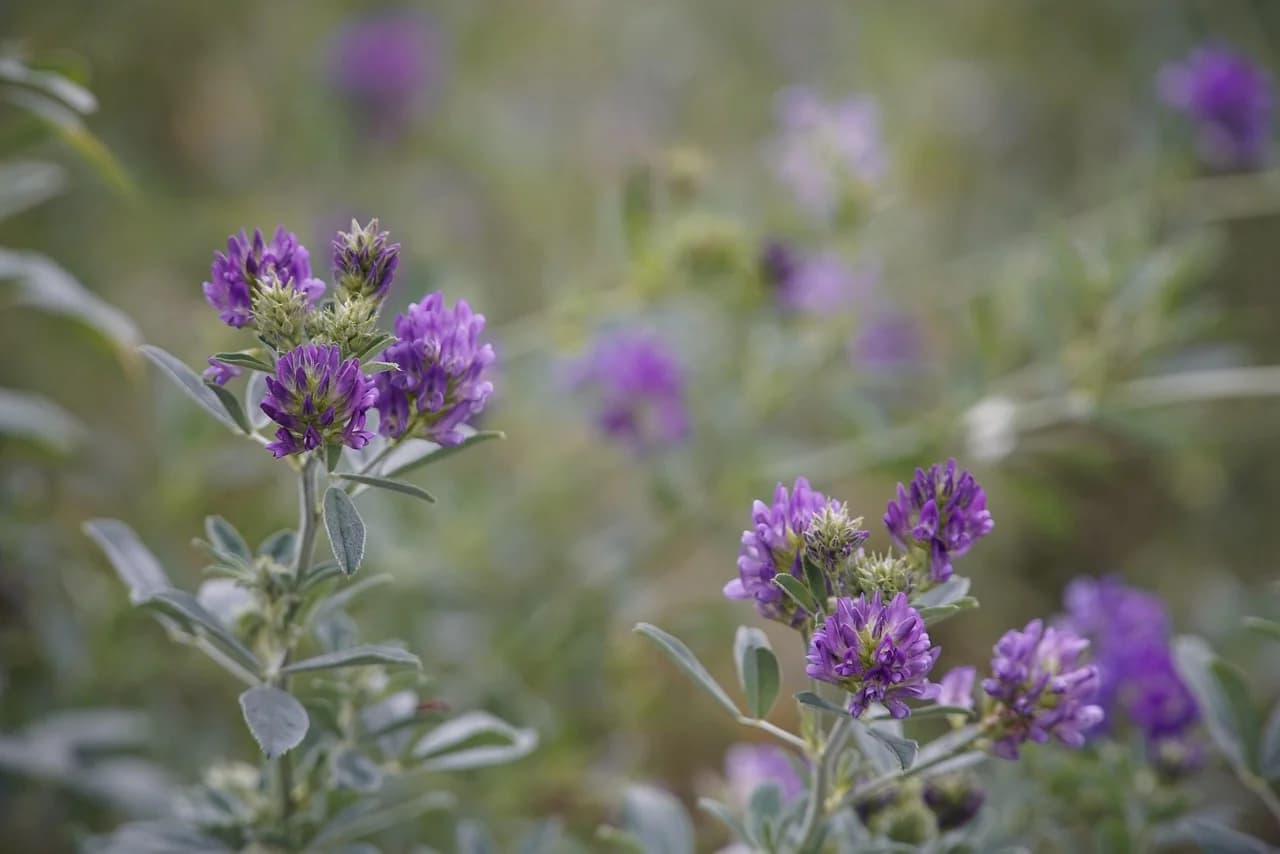
What it is. Alfalfa, also called lucerne, is a herbaceous perennial legume with a deep taproot and clover-like green leaves. It produces small purple flowers in summer, followed by flat, pea-like fruits.
Uses. It is grown in many countries as animal feed or as a green crop, and it can improve soil nutrient levels and soil structure. As a legume, it fixes nitrogen from the air with the help of bacteria on its roots.
Growing details
- Start indoors
- Not yet verified
- Sow outdoors
- Not yet verified
- Water
- Not yet verified
- Containers
- Not yet verified
- Height
- 0.5–1 m1½–3½ ft
- Spread
- 0.5–1 m1½–3½ ft
- Frost tolerance
- Hardy
- Soil pH
- Not yet verified
- Life cycle
- Perennial
- Hardiness zones
- Not yet verified
02 · How to grow
How to grow alfalfa from seed
When and how to sow. Sow the seed in a firm seedbed, about ¼ to ½ inch (0.6 to 1.3 cm) deep. Heavy soils call for no deeper than ¼ inch (0.6 cm), and light soils for no deeper than ½ inch (1.3 cm).
Sources differ on timing. One gives autumn as the time to sow seed, while another says early spring or late summer. Check your local last frost date and advice before choosing.
Inoculate the seed first. Alfalfa seed should be inoculated just before sowing to supply the nitrogen-fixing bacteria it needs. Most commercial seed comes pre-coated, but pre-inoculated seed should be re-inoculated if it isn’t used within 6 months.
Soil. Alfalfa will grow in most situations, including poor, dry soil. Nitrogen fixation falls as soil pH drops below 6.5, so keep the pH near neutral.
Replanting. Sowing alfalfa into an old alfalfa patch is very hard to do successfully because of autotoxicity.
03 · Care
Caring for alfalfa
Feeding. Nitrogen fertilizer is usually unnecessary for alfalfa, since it fixes its own nitrogen. Phosphorus tends to be the nutrient most likely to limit yields. Placing a starter fertilizer about an inch below the seed can give seedlings a head start.
Soil testing and lime. Test the soil before planting, since it is much more effective to fix nutrient gaps before sowing than after. Lime is needed on soils with a pH below 6.5.
At a glance
How alfalfa compares with other seeds in Fruits & other
Worked out from the growing facts of the 35 seeds in Fruits & other on SeedBattle.
- Alfalfa
- Each of the other seeds in Fruits & other
- Their average
- Sowing depthShallower than average
6 mm–1.5 cm¼–½ in
Average for Fruits & other: 2 cm⅞ in, from 11 other seeds
- HeightShorter than average
0.5–1 m1½–3½ ft
Average for Fruits & other: 3.2 m10½ ft, from 26 other seeds
04 · Problems
Common alfalfa problems
Pests and diseases. Alfalfa may be susceptible to alfalfa weevil, leafhoppers, spotted aphids and bacterial wilt. Removing fall growth may reduce the severity of alfalfa weevil the following spring.
05 · Harvest
Harvesting alfalfa
Grazing. Begin grazing when the alfalfa is about 6 inches (15 cm) tall. In fall, avoid grazing hard within 5 to 6 weeks of the first killing frost, and leave at least a 4-inch (10 cm) stubble.
06 · Safety
Alfalfa safety
Bloat in grazing animals. Bloat may be a problem when animals graze young, lush alfalfa. Fill animals with another roughage before turning them onto alfalfa for the first time.
Alfalfa questions
How deep should I sow alfalfa seeds?
Sow alfalfa about ¼ to ½ inch (0.6 to 1.3 cm) deep, with the shallower depth for heavy soils.
Does alfalfa need full sun?
Alfalfa is listed as growing in full sun or partial shade.
When should I sow alfalfa?
One source says to sow seed in autumn, while another says early spring or late summer.
Does alfalfa need fertilizer?
Nitrogen fertilizer is usually unnecessary for alfalfa because it fixes its own nitrogen.
Why does alfalfa seed need inoculant?
Alfalfa seed should be inoculated just before sowing so the nitrogen-fixing bacteria are present in the soil.
Quick answers
More alfalfa questions
Short answers taken from the growing facts on this page.
How tall does alfalfa grow?
Alfalfa grows 0.5–1 m1½–3½ ft tall.
Can alfalfa survive frost?
Yes. Alfalfa is hardy.
Is alfalfa an annual or a perennial?
Alfalfa is a perennial.
Side by side
Compare alfalfa with…
Two seeds, every growing fact lined up, so you can pick the one that suits your space.
Fruits & other
More seeds like alfalfa
Other seeds in the Fruits & other category.
Find your next seed to grow
Browse all 223 seeds by sun, difficulty or pot size, or line alfalfa up against another seed.