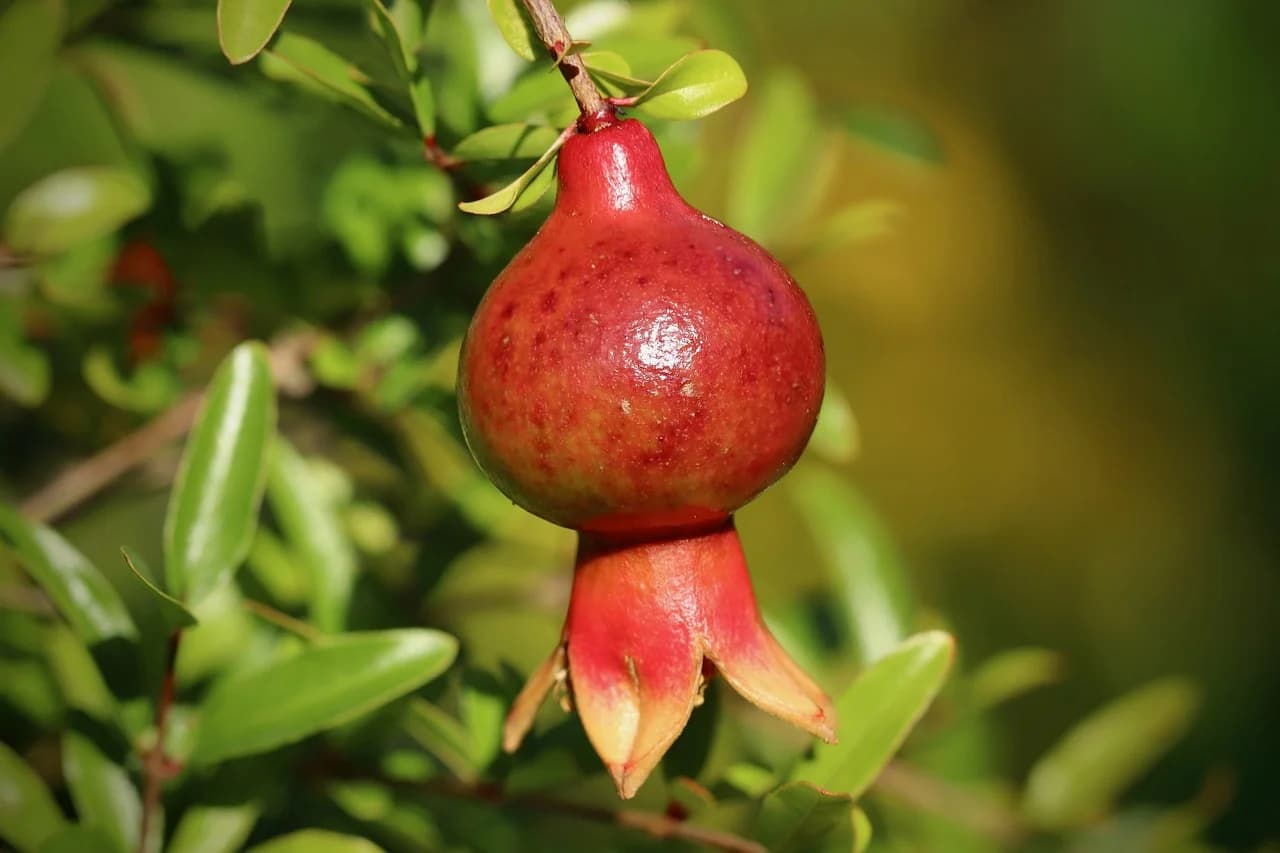
Pomegranate
Punica granatum
Pomegranate is a woody, deciduous perennial shrub or small tree that grows best in full sun. It can be sown from seed in spring, but cuttings are a common way to get plants that match the parent.
Quick facts
- Germination time
- Not yet verified
- Germination temperature
- 13–18 °C55–64 °F
- Sowing depth
- Not yet verified
- Spacing between plants
- 3–3.7 m10–12 ft
- Days to maturity
- Not yet verified
- Sun
- Full sun, partial shade
Safety for cats and dogs: not yet verified.
By SeedBattle EditorsReviewed by FahadUpdated
Spotted a mistake or missing detail? Improve this page
01 · Overview
About pomegranate
Pomegranate is a woody, deciduous, perennial shrub or tree native from northeast Turkey to Afghanistan. It is grown for its red-skinned fruit and its showy flowers, which attract hummingbirds. Plants usually grow 10 to 12 feet (305 to 366 cm) tall and 8 to 10 feet (244 to 305 cm) wide, though some descriptions give larger sizes for trees grown in the ground.
Growing details
- Start indoors
- Not yet verified
- Sow outdoors
- Not yet verified
- Water
- Not yet verified
- Containers
- Yes
- Height
- 3–3.7 m10–12 ft
- Spread
- 2.4–3 m8–10 ft
- Frost tolerance
- Not yet verified
- Soil pH
- Not yet verified
- Life cycle
- Perennial
- Hardiness zones
- USDA zones 8–11
02 · How to grow
How to grow pomegranate from seed
Sow seed in spring at about 55 to 64 °F (13 to 18 °C). Seed-grown plants may not be true to type, so many growers use cuttings instead. Cuttings of one-year-old wood, about 10 to 12 inches (25 to 30 cm) long, are taken in late winter and placed in warm rooting media.
Plant outdoors in full sun in a well-drained soil. Pomegranate grows in partial shade to full sun, but it needs full sun for the best fruit. Leave 10 to 12 feet (305 to 366 cm) between plants when growing for home use. Fruit needs warm autumn temperatures of 55 to 61 °F (13 to 16 °C) to ripen. Plants usually survive winter, but they can be killed back to the ground below 10 °F (-12 °C).
03 · Care
Caring for pomegranate
During growth, water well and apply a balanced liquid fertilizer monthly. Water sparingly in winter. Once established, plants tolerate drought, but fruiting plants need regular deep watering, about every 7 to 10 days. Mulch helps keep soil moisture steady between waterings.
Prune in late winter or early spring, because the plant blooms on new growth. Thin the inner foliage and remove suckers to improve airflow, and avoid heavy pruning, which reduces fruit.
At a glance
How pomegranate compares with other seeds in Fruits & other
Worked out from the growing facts of the 35 seeds in Fruits & other on SeedBattle.
- Pomegranate
- Each of the other seeds in Fruits & other
- Their average
- Germination temperatureCooler than average
13–18 °C55–64 °F
Average for Fruits & other: 22 °C72 °F, from 13 other seeds
- Spacing between plantsWider than average
3–3.7 m10–12 ft
Average for Fruits & other: 1.5 m5 ft, from 8 other seeds
- HeightAbout average
3–3.7 m10–12 ft
Average for Fruits & other: 3.1 m10½ ft, from 26 other seeds
04 · Problems
Common pomegranate problems
Caterpillars, whiteflies, mealybugs and scale may be present. Leaf spot, fruit blotch and root rot may occur. Honey fungus rarely affects this plant. Fruit cracking is often reported in home gardens, and regular watering is the best way to prevent it.
In the Southeast, pomegranates often fail to fruit reliably, mostly because of poor pollination and humid weather. Gardening experts recommend planting at least two plants for better cross-pollination, though one plant can be enough.
05 · Harvest
Harvesting pomegranate
Fruit is produced in fall. Choose fruit that feels heavy for its size and has no cracks or splits. Harvest before the fruit is overripe, even a little early, to avoid splitting.
06 · Storage
Storing pomegranate
Whole fruit keeps at room temperature for a few days, or in the refrigerator in plastic bags for up to 3 months. Fruit may store for 6 to 7 months at 32 to 41 °F (0 to 5 °C) with humidity around 80%.
Pomegranate questions
Can I grow pomegranate in a pot?
Yes, a container can be used, and in cold areas the plant may need to be moved indoors for winter.
When should I plant pomegranate seeds?
Seeds can be sown in spring at about 55 to 64 °F (13 to 18 °C). Seed-grown plants may not match the parent fruit.
How big does a pomegranate plant get?
Plants usually grow 10 to 12 feet (305 to 366 cm) tall and 8 to 10 feet (244 to 305 cm) wide.
Will pomegranate fruit in the Southeast?
Not reliably. Poor pollination and humid weather mostly limit fruiting in the Southeast.
Quick answers
More pomegranate questions
Short answers taken from the growing facts on this page.
How far apart should I plant pomegranate?
Space the plants 3–3.7 m10–12 ft apart.
How much sun does pomegranate need?
Pomegranate grows in full sun or partial shade.
What temperature do pomegranate seeds need to sprout?
Pomegranate seeds germinate at 13–18 °C55–64 °F.
How tall does pomegranate grow?
Pomegranate grows 3–3.7 m10–12 ft tall.
Is pomegranate an annual or a perennial?
Pomegranate is a perennial.
Which USDA zones can pomegranate grow in?
Pomegranate is hardy in USDA zones 8–11.
Side by side
Compare pomegranate with…
Two seeds, every growing fact lined up, so you can pick the one that suits your space.
Fruits & other
More seeds like pomegranate
Other seeds in the Fruits & other category.
Find your next seed to grow
Browse all 223 seeds by sun, difficulty or pot size, or line pomegranate up against another seed.
