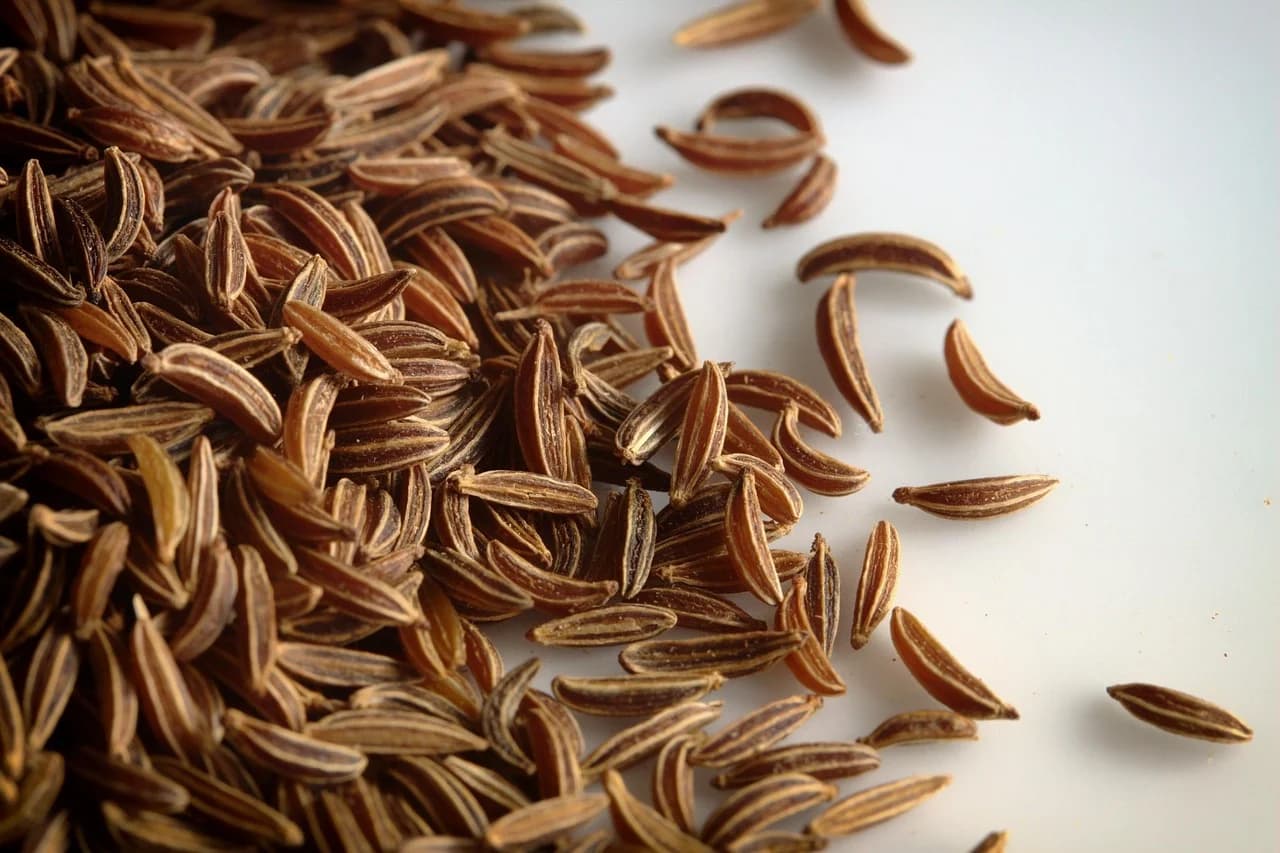
Caraway
Carum carvi
Caraway is a biennial herb grown mainly for its seeds, with edible leaves and roots. It is best sown directly in the garden in full sun and flowers in its second year.
Quick facts
- Germination time
- 10–14 days
- Germination temperature
- Not yet verified
- Sowing depth
- 6 mm¼ in
- Spacing between plants
- 20–30 cm8–12 in
- Days to maturity
- Not yet verified
- Sun
- Full sun, partial shade
Toxic to cats and dogs Read the safety notes
By SeedBattle EditorsUpdated
Spotted a mistake or missing detail? Improve this page
01 · Overview
About caraway
Caraway (Carum carvi) is an edible herb in the carrot family, Apiaceae. It is a biennial, so it takes two seasons to flower and set seed. Its seeds are the main crop, though the leaves and roots are edible too.
In the first year it forms a rosette of leaves 8 to 10 inches (20 to 25 cm) tall that looks like a carrot. Plants typically reach 1 to 2 feet (30 to 61 cm) tall and about 1 foot (30 cm) wide, with fragrant white flower clusters in late spring to early summer. Some accounts give taller figures of 2 to 3 feet (61 to 91 cm).
Growing details
- Start indoors
- Not yet verified
- Sow outdoors
- Not yet verified
- Water
- Moderate
- Containers
- Not yet verified
- Height
- 30–61 cm1–2 ft
- Spread
- 30 cm12 in
- Frost tolerance
- Not yet verified
- Soil pH
- pH 4.8–7.6
- Life cycle
- Biennial
02 · How to grow
How to grow caraway from seed
Sow seed directly in the garden in early spring or in fall. Caraway is hard to transplant successfully, so avoid moving seedlings once they are established.
Sow shallowly, about ¼ inch (6 mm) deep, with about 1 seed per inch in rows about 18 inches (45 cm) apart. Keep the seedbed moist, because the seed is slow to germinate. Seedlings usually appear in 10 to 14 days.
Full sun suits caraway best, and plants in full sun are richer in essential oils and more aromatic. It grows in moist, well-drained soil with a pH from 4.8 to 7.6, and it will tolerate heavier soils.
Established plants have deep roots and do not tolerate root disturbance. Thin plants to 8 to 12 inches (20 to 30 cm) apart in rows 3 feet (90 cm) apart. Some growers thin to 4 to 8 inches (10 to 20 cm). Seed sown in fall or in early spring both flower and seed in the second year, and fall-sown plants bear seed the following year.
03 · Care
Caring for caraway
Keep the soil evenly moist, since plants benefit from soil that stays uniformly moist. Cultivate the bed well while plants are young, because caraway does not compete well with weeds. Protect the roots with mulch in winter.
At a glance
How caraway compares with other herbs
Worked out from the growing facts of the 30 seeds in Herbs on SeedBattle.
- Caraway
- Each of the other herbs
- Their average
- Germination timeAbout average
10–14 days
Average for herbs: 12 days, from 20 other seeds
- Sowing depthAbout average
6 mm¼ in
Average for herbs: 6 mm¼ in, from 16 other seeds
- Spacing between plantsCloser than average
20–30 cm8–12 in
Average for herbs: 35 cm14 in, from 13 other seeds
- HeightShorter than average
30–61 cm1–2 ft
Average for herbs: 70 cm2½ ft, from 27 other seeds
04 · Problems
Common caraway problems
Watch for carrot root fly, aphids, and parsley worms, and note that anthracnose and white mold are possible diseases. One account says the plant is generally pest-free and disease-free.
Plants often self-sow freely. If the seed is not harvested, it falls and sprouts the following spring, which can become overwhelming for a new gardener.
05 · Harvest
Harvesting caraway
Pull or cut the plants as soon as the fruits begin to ripen to limit seed loss. Seeds can be picked when ripe, about a month after flowering, when they turn a grayish-brown color. Fresh leaves can be picked as needed, and roots can be dug while plants are young.
06 · Storage
Storing caraway
Place the seed heads in a paper bag in a cool, dry, well-ventilated place to dry, then rub the seeds free by hand. Make sure the seeds are thoroughly dry before storing them.
07 · Safety
Caraway safety
Caraway is listed as toxic to dogs and to cats, with mild vomiting and diarrhea as the signs to watch for. Caraway is an edible herb for people, but keep poisonous plants with similar umbel-shaped flowers, such as hemlock, out of the caraway bed.
Caraway questions
How long do caraway seeds take to germinate?
Seedlings usually emerge in 10 to 14 days. Because the seed is slow to germinate, keep the seedbed moist.
When should I plant caraway?
Sow it directly in the garden in early spring or in fall. Plants sown in fall bear seed the following year.
Is caraway a biennial or an annual?
Caraway is a biennial that produces seed the second season after planting. Gardeners in mild-winter areas may grow it as an annual by planting seed in winter.
Is caraway safe for dogs and cats?
It is listed as toxic to both dogs and cats.
Quick answers
More caraway questions
Short answers taken from the growing facts on this page.
How deep should I sow caraway seeds?
Sow them 6 mm¼ in deep.
How far apart should I plant caraway?
Space the plants 20–30 cm8–12 in apart.
How much sun does caraway need?
Caraway grows in full sun or partial shade.
How tall does caraway grow?
Caraway grows 30–61 cm1–2 ft tall.
What soil pH does caraway need?
Aim for soil at pH 4.8–7.6.
How much water does caraway need?
Caraway has moderate water needs.
Side by side
Compare caraway with…
Two seeds, every growing fact lined up, so you can pick the one that suits your space.
Herbs
More seeds like caraway
Other seeds in the Herbs category.
Find your next seed to grow
Browse all 223 seeds by sun, difficulty or pot size, or line caraway up against another seed.
