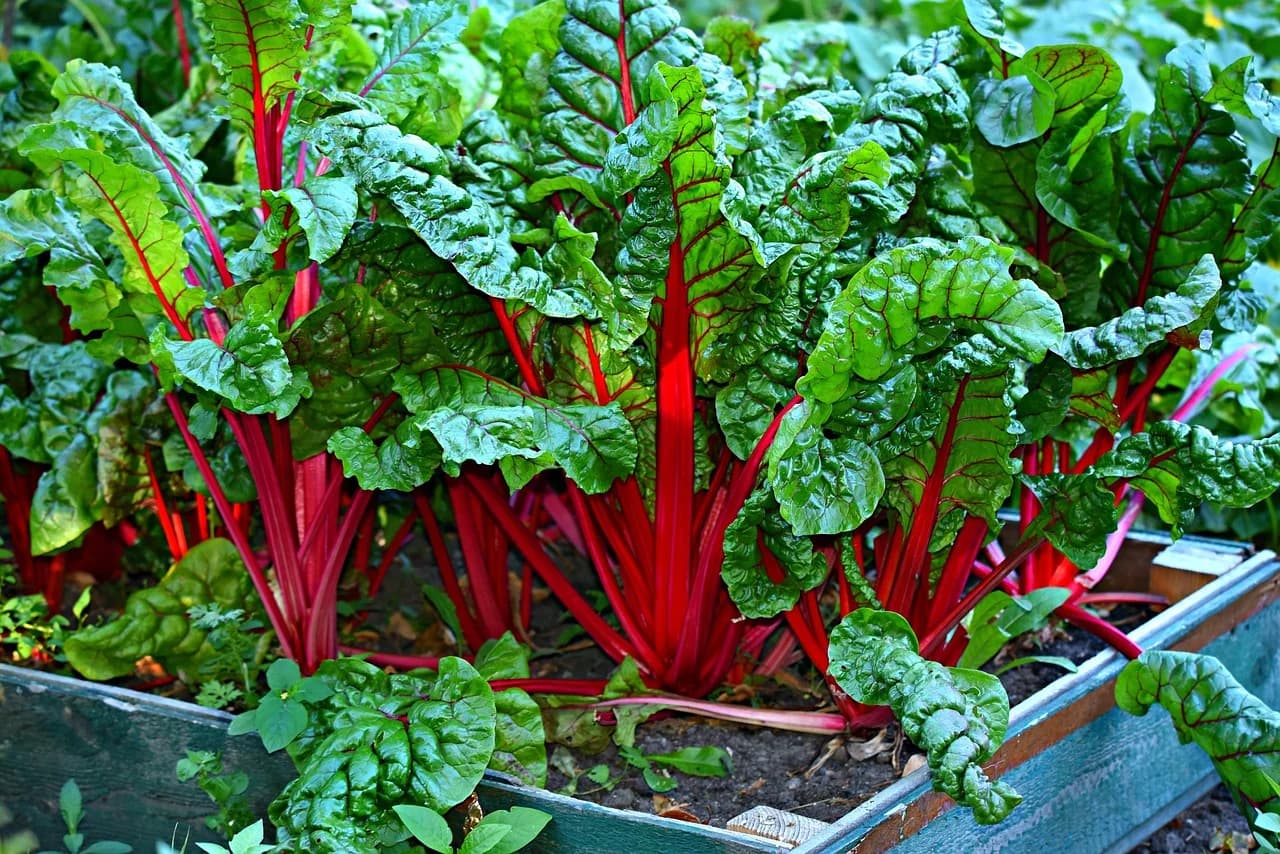
Swiss Chard
Beta vulgaris var. cicla
Also called chard, silverbeet
Swiss chard is a leafy green with colorful stalks that sprouts in 7 to 14 days and grows in full sun or partial shade.
Quick facts
- Germination time
- 7–14 days
- Germination temperature
- 13–24 °C55–75 °F
- Sowing depth
- Not yet verified
- Spacing between plants
- Not yet verified
- Days to maturity
- 50–70 days from sowing
- Sun
- Full sun, partial shade
Non-toxic to cats and dogs
By SeedBattle EditorsUpdated
Spotted a mistake or missing detail? Improve this page
01 · Overview
About swiss chard
What it is. Swiss chard (Beta vulgaris var. cicla) is a leafy green from the same species as beet, but it does not grow a swollen root. It is also called silverbeet and perpetual spinach. Its leaves are large and ruffled, with stalks in white, pink, gold, orange, or red depending on the variety. Because the stalks are so colorful, it also works in flower beds and containers as an ornamental edible.
Life cycle. Extension guides describe it as a biennial that is usually grown as an annual. Gardening experts profile lists both annual and biennial types within the leaf beet group.
Growing details
- Start indoors
- Not yet verified
- Sow outdoors
- Not yet verified
- Water
- Moderate
- Containers
- Not yet verified
- Height
- 30–61 cm1–2 ft
- Spread
- 20–46 cm8–18 in
- Frost tolerance
- Half-hardy (light frost)
- Soil pH
- pH 6.0–8.0
- Life cycle
- Not yet verified
Sowing timeline
Swiss chard from seed to maturity
Counted in days from the day you sow.
- Germination temperature
- 13–24 °C55–75 °F
- Frost tolerance
- Half-hardy (light frost)
02 · How to grow
How to grow swiss chard from seed
When and how to sow. Sow seed directly in the garden in early spring or late summer. Gardening experts advise sowing once the soil reaches 40 °F (4 °C). Each seed is actually a small cluster with several embryos, so you will need to thin seedlings unless you buy monogerm seed.
Depth and germination. Plant seed about ½ inch (1.3 cm) deep and cover it with fine soil. Maryland also suggests 1 inch (2.5 cm) in sandy soil, and Wisconsin advises planting an inch deep. Seedlings emerge in 7 to 14 days, with the best germination at 55 to 75 °F (13 to 24 °C). Gardening experts report a wider range of 40 to 100 °F (5 to 38 °C), with the best at 86 °F (30 °C). Temperatures above 80 °F (27 °C) reduce germination.
Thinning and spacing. Thin seedlings to about 4 inches (10 cm) apart when they are about 2 inches (5 cm) tall. Other guides give wider final spacing: about 6 inches (15 cm) apart in rows 12 inches (30 cm) apart, or 8 to 12 inches (20 to 30 cm) apart for larger plants. Gardening experts suggest 4 to 6 inches (10 to 15 cm) apart for larger leaves.
Starting indoors. Seeds can be started indoors 5 to 6 weeks before transplanting. Transplants with 4 to 6 mature leaves usually take 5 to 6 weeks to grow. Gardening experts suggest transplanting about four weeks after starting seeds indoors.
Light and soil. Swiss chard grows in full sun to partial shade. Maryland says it grows best with 6 to 8 hours of direct sun and tolerates partial shade of 4 to 6 hours. It prefers fertile, well-drained soil rich in organic matter, with a pH of 6.0 to 8.0.
Containers. It grows well in containers, doing best in a pot at least 2 quarts (about 1.9 L) and 8 inches (20 cm) deep.
03 · Care
Caring for swiss chard
Watering. Keep the soil evenly moist and water deeply and regularly during dry spells. Gardening experts suggest 1 to 2 inches (2.5 to 5 cm) of water per week. Mulch helps conserve moisture and reduce weeds.
Feeding and weeds. Chard needs a high supply of nutrients from soil organic matter or fertilizer. Gardening experts suggest ¼ cup of 21-0-0 nitrogen fertilizer per 10 feet of row, placed beside the plants 4 weeks after transplanting or thinning. Swiss chard does not compete well with weeds, so pull young weeds by hand and keep plants closely spaced.
At a glance
How swiss chard compares with other vegetables
Worked out from the growing facts of the 79 seeds in Vegetables on SeedBattle.
- Swiss Chard
- Each of the other vegetables
- Their average
- Germination timeAbout average
7–14 days
Average for vegetables: 10 days, from 39 other seeds
- Days to maturityAbout average
50–70 days from sowing
Average for vegetables: 65 days, from 17 other seeds
- Germination temperatureCooler than average
13–24 °C55–75 °F
Average for vegetables: 23 °C73 °F, from 38 other seeds
- HeightShorter than average
30–61 cm1–2 ft
Average for vegetables: 94 cm3 ft, from 57 other seeds
04 · Problems
Common swiss chard problems
Pests and disease. Gardening experts list no significant problems for this plant group. Maryland lists bolting, Cercospora leaf spot, leafminer, and root knot nematodes. Root knot nematodes cause swollen galls on the roots. Wisconsin mentions aphids and leafminers, and says to remove any plants that bolt and any leaves with mines. Gardening experts add slugs and flea beetles, which can damage seedlings.
05 · Harvest
Harvesting swiss chard
Harvesting. Pick the outer leaves first so the inner leaves keep growing. Gardening experts suggest harvesting outer leaves when they are 4 to 12 inches (10 to 30 cm) long. Baby leaves can be picked in roughly 30 days and mature leaves in about 60. Leaves smaller than 4 inches (10 cm) can be eaten raw in salads, while larger leaves are chopped and sautéed. To rejuvenate a plant, snip leaves about 2 inches (5 cm) above the crowns, and harvesting can continue until frost.
06 · Storage
Storing swiss chard
Storage. Chard is very perishable. Store it in the refrigerator in a vented mesh or plastic bag, in cold, humid conditions near 32 °F (0 °C) and 95% relative humidity. Gardening experts and Wisconsin both say it keeps for about 1 to 2 weeks in the refrigerator. Wisconsin notes it can also be frozen, dried, or canned.
07 · Safety
Swiss Chard safety
Safety. Gardening experts list Swiss chard as non-toxic for cats and dogs. These are pet ratings only; the profile gives no toxicity rating for people. Maryland notes that all parts of the chard plant contain oxalic acid, which is not a toxicity rating for people or pets.
Swiss Chard questions
How long do Swiss chard seeds take to germinate?
Swiss chard seedlings usually emerge in 7 to 14 days. Germination is best at 55 to 75 °F (13 to 24 °C).
Can I grow Swiss chard in a pot?
Yes. Gardening experts say it grows well in containers, doing best in a pot at least 2 quarts (about 1.9 L) and 8 inches (20 cm) deep.
When should I plant Swiss chard?
Maryland recommends direct sowing in early spring and late summer. Gardening experts advise sowing once the soil reaches 40 °F (4 °C).
How long does Swiss chard take to mature?
Maryland gives 50 to 70 days from direct sowing. Gardening experts give 40 to 45 days to reach maturity.
Is Swiss chard safe for cats and dogs?
Gardening experts list Swiss chard as non-toxic for cats and dogs. The profile gives no toxicity rating for people.
Quick answers
More swiss chard questions
Short answers taken from the growing facts on this page.
How much sun does swiss chard need?
Swiss chard grows in full sun or partial shade.
What temperature do swiss chard seeds need to sprout?
Swiss chard seeds germinate at 13–24 °C55–75 °F.
How tall does swiss chard grow?
Swiss chard grows 30–61 cm1–2 ft tall.
Can swiss chard survive frost?
Only a light frost. Swiss chard is half-hardy.
What soil pH does swiss chard need?
Aim for soil at pH 6.0–8.0.
How much water does swiss chard need?
Swiss chard has moderate water needs.
Side by side
Compare swiss chard with…
Two seeds, every growing fact lined up, so you can pick the one that suits your space.
Vegetables
More seeds like swiss chard
Related seeds, plus others in the Vegetables category.
Find your next seed to grow
Browse all 223 seeds by sun, difficulty or pot size, or line swiss chard up against another seed.
