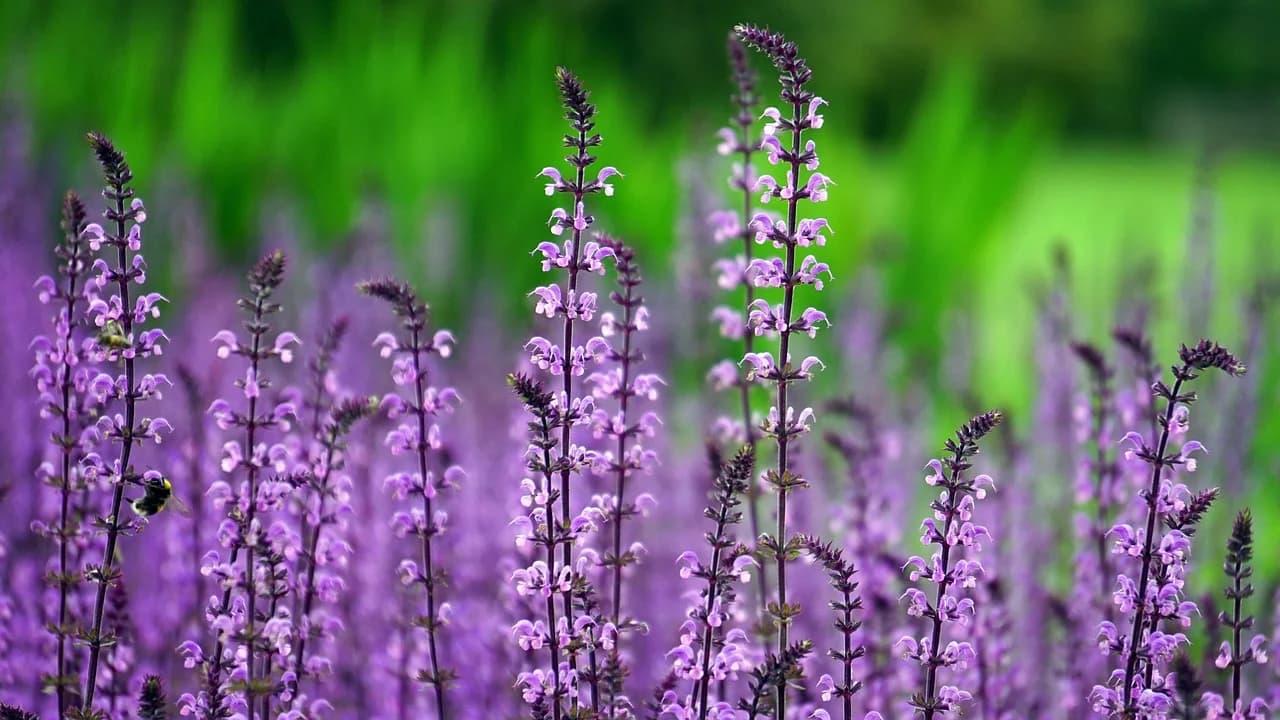
Woodland Sage
Salvia nemorosa
Also called balkan clary, perennial salvia
Woodland sage is a clump-forming perennial with violet-blue flower spikes from June to September. It grows in full sun to partial shade and is drought tolerant once established.
Quick facts
- Germination time
- Not yet verified
- Germination temperature
- Not yet verified
- Sowing depth
- Not yet verified
- Spacing between plants
- Not yet verified
- Days to maturity
- Not yet verified
- Sun
- Full sun, partial shade
Safety for cats and dogs: not yet verified.
By SeedBattle EditorsUpdated
Spotted a mistake or missing detail? Improve this page
01 · Overview
About woodland sage
Woodland sage (Salvia nemorosa), also called Balkan clary, is a clump-forming perennial native to Europe and west-central Asia. Its violet-blue flowers appear on dense spikes from June to September, and bees, butterflies and hummingbirds visit them. Flower colors across its range include blue, purple, pink and white.
Cultivars vary in color and size. ‘Caradonna’ has dark purple stems with blue-violet flowers, ‘Pink Profusion’ has very pale pink flowers, and ‘Violet Profusion’ has good resistance to some diseases.
Growing details
- Start indoors
- Not yet verified
- Sow outdoors
- Not yet verified
- Water
- Low
- Containers
- Yes
- Height
- 46–91 cm1½–3 ft
- Spread
- 15–61 cm½–2 ft
- Frost tolerance
- Not yet verified
- Soil pH
- Not yet verified
- Life cycle
- Perennial
- Hardiness zones
- USDA zones 4–8
02 · How to grow
How to grow woodland sage from seed
Woodland sage can be grown from seed or by division in spring, and it can also be started from stem cuttings. Plant it where it gets full sun or light partial shade, since it grows in full sun to partial shade.
It does best in moderately fertile, humus-rich soil that stays moist but drains well. It prefers sandy or gravelly soil but tolerates most well-drained soils, even dry ones. Once established, it is drought tolerant. Mature plants reach 1½ to 3 feet (46 to 91 cm) tall and 6 inches to 2 feet (15 to 61 cm) wide. For the best effect, plant it in the front of a border in groups of three or more.
03 · Care
Caring for woodland sage
Once the flowering stem has finished blooming and turned brown, cut it down to the basal leaves and new flowers will appear. Removing spent flower spikes can prolong flowering, and the plant can often be encouraged to bloom several times this way.
Mulch in spring.
At a glance
How woodland sage compares with other flowers
Worked out from the growing facts of the 79 seeds in Flowers on SeedBattle.
- Woodland Sage
- Each of the other flowers
- Their average
- HeightAbout average
46–91 cm1½–3 ft
Average for flowers: 70 cm2½ ft, from 68 other seeds
04 · Problems
Common woodland sage problems
Woodland sage has no serious problems. It may be susceptible to slugs and snails, and honey fungus is rare but possible. Powdery mildews, verticillium wilt and foot and root rots can also affect it. Some cultivars have shown good resistance to phytophthora and aerial blight. Deer and rabbits seldom damage it.
05 · Harvest
Harvesting woodland sage
The flowers are listed as good for cutting.
Woodland Sage questions
Is woodland sage a perennial?
Yes. It is a clump-forming, herbaceous perennial.
How tall does woodland sage grow?
Mature plants reach about 1½ to 3 feet (46 to 91 cm) tall and 6 inches to 2 feet (15 to 61 cm) wide.
Does woodland sage need full sun?
It grows in full sun to partial shade and does best in full sun, though it can tolerate light partial shade.
Does woodland sage attract pollinators?
Yes. Its flowers attract hummingbirds, bees and butterflies.
Is woodland sage deer resistant?
It is seldom damaged by deer or rabbit browsing.
Quick answers
More woodland sage questions
Short answers taken from the growing facts on this page.
Can I grow woodland sage in a pot?
Yes, woodland sage grows in containers.
How much water does woodland sage need?
Woodland sage has low water needs.
Which USDA zones can woodland sage grow in?
Woodland sage is hardy in USDA zones 4–8.
Side by side
Compare woodland sage with…
Two seeds, every growing fact lined up, so you can pick the one that suits your space.
Flowers
More seeds like woodland sage
Related seeds, plus others in the Flowers category.
Find your next seed to grow
Browse all 223 seeds by sun, difficulty or pot size, or line woodland sage up against another seed.
