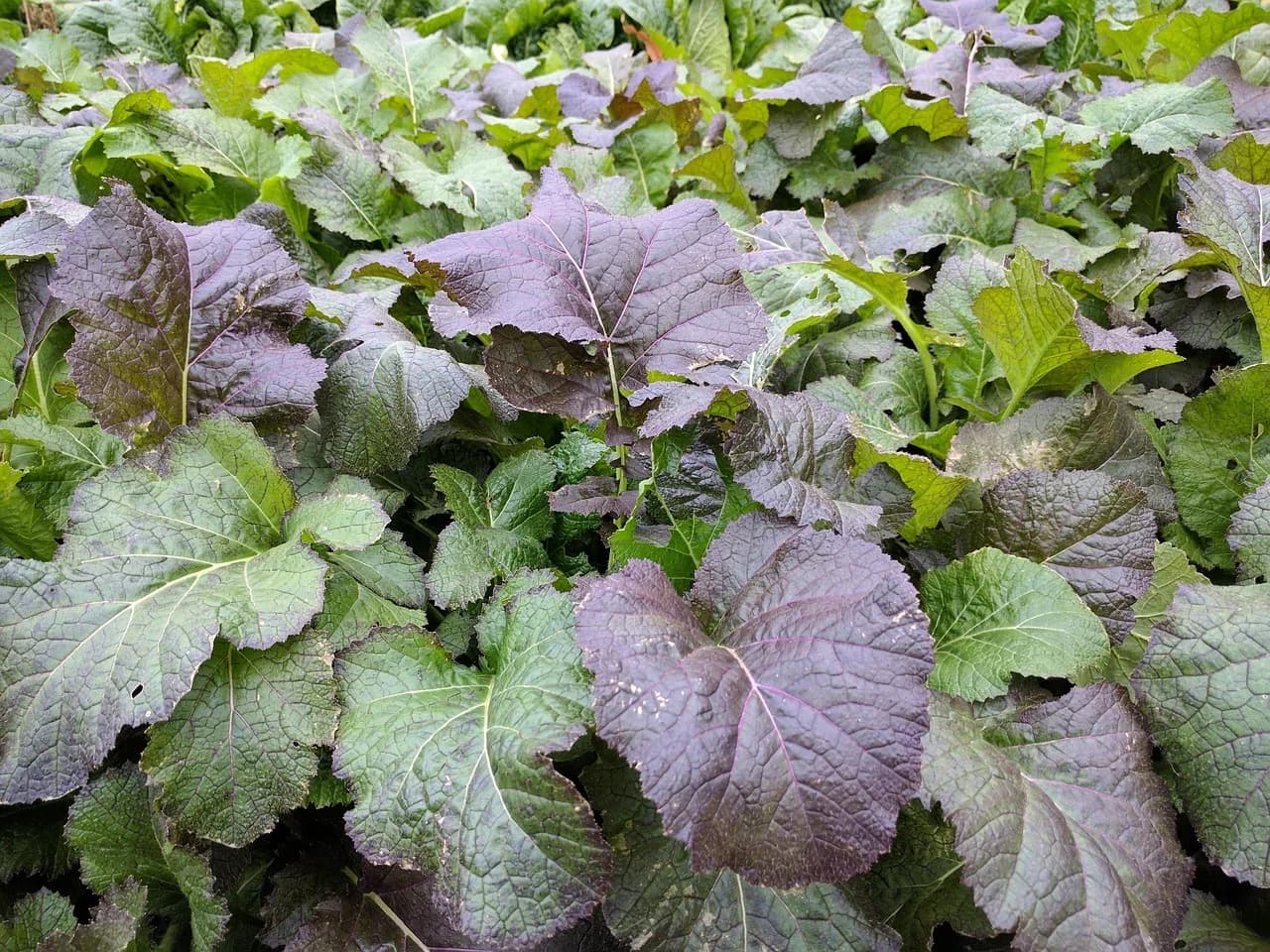
Mustard Greens
Brassica juncea
Also called mustard, leaf mustard
Mustard greens (Brassica juncea) are a fast-growing annual leafy green with a hot, spicy flavor. Sow in spring or fall in full sun to part shade, and keep the soil evenly moist.
Quick facts
- Germination time
- 7–10 days
- Germination temperature
- 13–18 °C55–64 °F
- Sowing depth
- 1.5 cm½ in
- Spacing between plants
- Not yet verified
- Days to maturity
- 25–50 days from sowing
- Sun
- Full sun, partial shade
Safety for cats and dogs: not yet verified.
By SeedBattle EditorsUpdated
Spotted a mistake or missing detail? Improve this page
01 · Overview
About mustard greens
Mustard greens (Brassica juncea) are an annual herb in the mustard family. The leaves and flowers are eaten, and all parts are edible when young. Young leaves go into mixed salads, while older leaves are usually cooked as greens. Leaf shape and color vary widely, from flat to curled and from green to red-tinged. Mature plants are listed at 12 to 18 inches (30 to 46 cm) tall and wide. The plant is listed as invasive in some mid-western states, so check local rules before planting.
The flowers are yellow and bloom in summer and fall, and they draw bees.
Growing details
- Start indoors
- Not yet verified
- Sow outdoors
- 2–3 weeks before the last frost
- Water
- Moderate
- Containers
- Yes
- Height
- 30–46 cm12–18 in
- Spread
- 30–46 cm12–18 in
- Frost tolerance
- Not yet verified
- Soil pH
- pH 6.0–8.0
- Life cycle
- Annual
Sowing timeline
When to sow mustard greens seeds
Counted from your area's average last spring frost date. Find yours from a local weather service or garden center, then count back or forward.
- Germination temperature
- 13–18 °C55–64 °F
02 · How to grow
How to grow mustard greens from seed
Sow seeds outdoors about 2 to 3 weeks before the last spring frost. Seed can be sown from early spring to late summer. Mustard can be sown after the soil reaches 40 °F (4 °C).
Plant the seed about ½ inch (1.3 cm) deep. A seed company suggests ¼ to ½ inch (0.6 to 1.3 cm) deep. Seed planted deeper than ½ inch likely will not germinate.
Seeds germinate best at 55 to 65 °F (13 to 18 °C) and emerge in 7 to 10 days. Mustard grows best when temperatures stay at or below 75 °F (24 °C).
For spring, transplants are the preferred planting material, because seeds germinate slowly in cool spring soil. For fall, direct seeding works well in late summer, when the soil is much warmer. For a fall crop, pick early maturing cultivars and plant 50 to 75 days before the expected maturity date.
03 · Care
Caring for mustard greens
Watering. Water regularly to keep the soil uniformly moist, since moisture swings make leaves tough and add off-flavors. Watering early in the day lets the leaves dry before night, which lowers the chance of fungal disease.
Feeding. Apply about ½ cup of nitrogen fertilizer (21-0-0) per 10 feet (3 m) of row, 4 weeks after transplanting or thinning.
Weeds and thinning. Mustard does not compete well with weeds, so control them early. Thin the stand when plants have three to four true leaves. Mulch with grass clippings, straw or shredded newspaper to help control weeds.
At a glance
How mustard greens compares with other vegetables
Worked out from the growing facts of the 79 seeds in Vegetables on SeedBattle.
- Mustard Greens
- Each of the other vegetables
- Their average
- Germination timeSprouts sooner than average
7–10 days
Average for vegetables: 10 days, from 39 other seeds
- Days to maturityMatures sooner than average
25–50 days from sowing
Average for vegetables: 66 days, from 17 other seeds
- Germination temperatureCooler than average
13–18 °C55–64 °F
Average for vegetables: 23 °C73 °F, from 38 other seeds
- Sowing depthDeeper than average
1.5 cm½ in
Average for vegetables: 1 cm½ in, from 58 other seeds
- HeightShorter than average
30–46 cm12–18 in
Average for vegetables: 94 cm3 ft, from 57 other seeds
04 · Problems
Common mustard greens problems
Heat and uneven moisture are the main quality problems. Growing mustard above 75 °F (24 °C) causes a bitter flavor. Spring plantings may bolt as the weather warms. Moisture and temperature stress lead to a spicier, unpleasantly strong flavor.
Insects that affect this plant include flea beetles, caterpillars, aphids, slugs and snails. Flea beetles feed on seedlings, and they can reduce plant stands or kill seedlings.
The main disease issues of greens include leaf spots, bacterial blight, black rot and crown and root rots. ‘Carolina Broadleaf’ is described as one of the few bacterial blight resistant cultivars.
05 · Harvest
Harvesting mustard greens
Harvest when the leaves reach full size, and before the seed stalk forms. Pick the outer leaves and leave the center to keep growing. Older leaves are often stripped first so the young leaves keep growing. If the growing point is not damaged, all leaves can be cut off to within 2 inches (5 cm) of the soil.
06 · Storage
Storing mustard greens
Harvested leaves can be stored in the fridge for 3 to 5 days. Eating greens within a week and storing them in a plastic bag in the refrigerator is advised. Mustard can also be stored for 1 to 2 weeks at 32 °F (0 °C) and 95% relative humidity.
07 · Safety
Mustard Greens safety
Mustard is listed as a problem for horses. The pages used here do not say which part of the plant or how much is a risk, so keep horses away from plantings and harvested leaves until a clearer source is added.
Mustard Greens questions
How long do mustard greens take to germinate?
Seeds usually emerge in 7 to 10 days and germinate best at 55 to 65 °F (13 to 18 °C).
When should I plant mustard greens?
Sow outdoors about 2 to 3 weeks before the last spring frost. Direct seeding in late summer also works well for a fall harvest.
Can I grow mustard greens in a pot?
Yes, the page says this plant can be grown in a container.
Why do my mustard greens taste too hot or bitter?
Mustard grows best at or below 75 °F (24 °C), and high heat causes bitterness. Moisture and temperature stress also make the flavor spicier and stronger.
Quick answers
More mustard greens questions
Short answers taken from the growing facts on this page.
How deep should I sow mustard greens seeds?
Sow them 1.5 cm½ in deep.
How much sun does mustard greens need?
Mustard greens grows in full sun or partial shade.
What temperature do mustard greens seeds need to sprout?
Mustard greens seeds germinate at 13–18 °C55–64 °F.
How long does mustard greens take to mature?
Mustard greens takes 25–50 days from sowing to mature.
How tall does mustard greens grow?
Mustard greens grows 30–46 cm12–18 in tall.
Is mustard greens an annual or a perennial?
Mustard greens is an annual.
Side by side
Compare mustard greens with…
Two seeds, every growing fact lined up, so you can pick the one that suits your space.
Vegetables
More seeds like mustard greens
Related seeds, plus others in the Vegetables category.
Find your next seed to grow
Browse all 223 seeds by sun, difficulty or pot size, or line mustard greens up against another seed.
