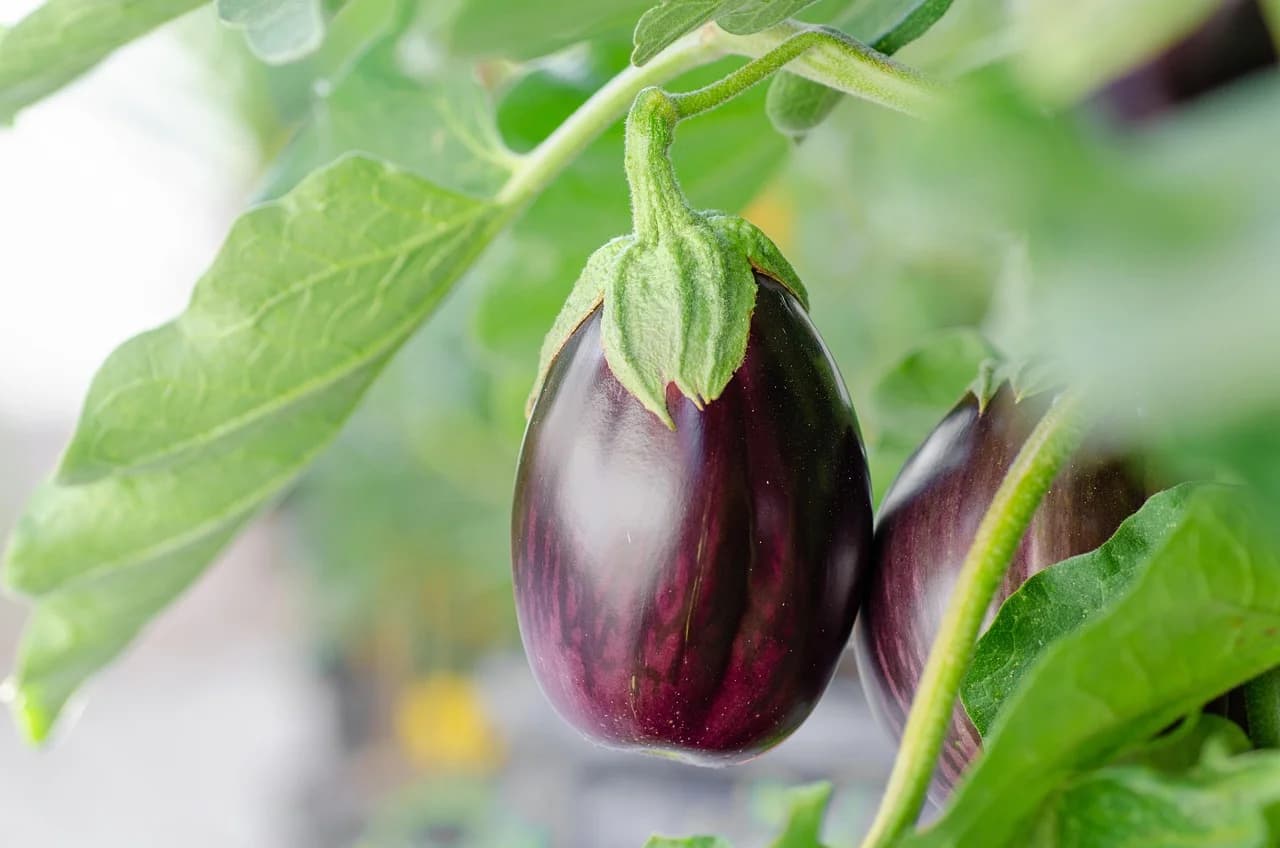
Eggplant
Solanum melongena
Also called aubergine, brinjal
Eggplant is a warm-season annual that needs full sun, warm weather and a long season, so many gardeners start with transplants.
Quick facts
- Germination time
- 8–12 days
- Germination temperature
- 21–32 °C70–90 °F
- Sowing depth
- 1.5 cm½ in
- Spacing between plants
- 61 cm2 ft
- Days to maturity
- 100–120 days from sowing
- Sun
- Full sun
Safety for cats and dogs: not yet verified.
By SeedBattle EditorsUpdated
Spotted a mistake or missing detail? Improve this page
01 · Overview
About eggplant
Eggplant (Solanum melongena), also called aubergine or brinjal, belongs to the nightshade family along with tomatoes, potatoes and peppers. It is a very tender, warm-season annual. Gardening experts list it as an annual in North Carolina, though it can be a short-lived perennial. Fruit colors range from white, green and purple to black depending on the variety.
Growing details
- Start indoors
- Not yet verified
- Sow outdoors
- Not yet verified
- Water
- Moderate
- Containers
- Yes
- Height
- 0.6–1.2 m2–4 ft
- Spread
- 30–91 cm1–3 ft
- Frost tolerance
- Tender (no frost)
- Soil pH
- pH 5.5–6.8
- Life cycle
- Annual
Sowing timeline
Eggplant from seed to maturity
Counted in days from the day you sow.
- Germination temperature
- 21–32 °C70–90 °F
- Frost tolerance
- Tender (no frost)
02 · How to grow
How to grow eggplant from seed
Sowing. Sow seeds in a prepared potting mix about ½ inch (1.3 cm) deep. Seeds germinate in 8 to 12 days and germinate quickly when the soil is between 70 and 90 °F (21 to 32 °C). Seeds do not germinate well in cold soil, so gardening experts suggest a heat mat set to 80 °F (27 °C) until seedlings emerge.
Transplanting. Set plants out in spring after the last chance of frost and once the soil has warmed thoroughly. Gardening experts suggest 6 to 8 week old transplants, while Maryland recommends 8 to 10 week old transplants. Avoid tall, spindly transplants or plants already flowering, since blossoms slow growth after transplanting.
Spacing and sun. Space plants 24 inches (61 cm) apart in the row. Other guides give 18 to 24 inches (46 to 61 cm) in row and 30 to 36 inches (76 to 91 cm) between rows, or 2 to 2½ feet (61 to 76 cm) apart with rows 3 to 4 feet (91 to 122 cm) apart. Plant in full sun, which means at least 6 hours of direct light a day; Maryland notes it prefers 8 to 10 hours.
03 · Care
Caring for eggplant
Watering. Keep the soil evenly moist, since a uniform moisture supply matters most during fruit set and fruit development. Gardening experts advise watering deeply and infrequently, about 1 to 2 inches (2.5 to 5 cm) per week, and notes that irregular watering can cause tough fruit or root rot.
Mulch and support. Black plastic mulch or black landscape fabric can give earlier harvests and higher yields. Do not put organic mulch around plants until the soil is warmer than 75 °F (24 °C). When plants reach about 12 inches (30 cm) tall, nip the growing tip to encourage branching, and support plants with cages or a trellis.
Feeding. Eggplant needs moderate fertilizer, and a soil test is the best guide. Avoid over-fertilizing, which encourages leafy growth and delays flowering and fruiting.
At a glance
How eggplant compares with other vegetables
Worked out from the growing facts of the 79 seeds in Vegetables on SeedBattle.
- Eggplant
- Each of the other vegetables
- Their average
- Germination timeAbout average
8–12 days
Average for vegetables: 10 days, from 39 other seeds
- Days to maturityTakes longer than average
100–120 days from sowing
Average for vegetables: 62 days, from 17 other seeds
- Germination temperatureWarmer than average
21–32 °C70–90 °F
Average for vegetables: 22 °C72 °F, from 38 other seeds
- Sowing depthDeeper than average
1.5 cm½ in
Average for vegetables: 1 cm½ in, from 58 other seeds
- Spacing between plantsWider than average
61 cm2 ft
Average for vegetables: 34 cm13 in, from 43 other seeds
- HeightAbout average
0.6–1.2 m2–4 ft
Average for vegetables: 93 cm3 ft, from 57 other seeds
04 · Problems
Common eggplant problems
Flea beetles, tomato hornworms, Colorado potato beetles and cutworms are potential pests. Flea beetles are a common pest and can cause shothole damage to leaves. Verticillium wilt can occur; gardening experts recommend disease-resistant cultivars and crop rotation. Gardening experts note there is no varietal resistance to Verticillium wilt, and crop rotation can help reduce it. Sunscald can happen when fruit is exposed to hot, dry sun, so gardening experts suggest keeping soil moisture uniform and keeping good leaf cover.
05 · Harvest
Harvesting eggplant
Harvest when the skin is very glossy and an indentation remains when the side of the fruit is pressed gently with a thumbnail. Cut the stems with pruners or a sharp knife, because the stems are tough. Fruit gets stringy and bitter as it matures, so pick it while it is still young. Harvesting often, at least weekly, keeps production going.
06 · Storage
Storing eggplant
Mature eggplant keeps about 1 week at 45 to 50 °F (7 to 10 °C) and 90 percent humidity. Gardening experts give 50 to 55 °F (10 to 13 °C) for about 7 days and warns that refrigerated fruit can suffer chilling injury.
07 · Safety
Eggplant safety
Gardening experts say caution should be taken to protect children and pets. The fruits and seeds are edible, but the fruits should not be eaten raw. Gardening experts say the flowers, leaves, stems and roots are poisonous and should not be eaten, and that swallowing them can cause throat burning, nausea, vomiting and irregular heart rhythm, which may be fatal. The plant is also listed as a problem for cats and dogs.
Eggplant questions
How long do eggplant seeds take to germinate?
Eggplant seeds usually germinate in 8 to 12 days. They germinate quickly when the soil is between 70 and 90 °F (21 to 32 °C).
Can I grow eggplant in a pot?
Yes, gardening experts say eggplants can be grown in-ground, in raised beds and in containers. The source does not state a pot size.
When should I plant eggplant outdoors?
Plant eggplant in spring after the last chance of frost and when the soil has thoroughly warmed. Gardening experts say eggplant can go outdoors in mid-May in central Iowa.
How many days does eggplant take to harvest from seed?
Gardening experts say starting from seed, eggplant takes about 100 to 120 days to reach maturity. Maryland counts 55 to 80 days from transplanting instead.
Quick answers
More eggplant questions
Short answers taken from the growing facts on this page.
How deep should I sow eggplant seeds?
Sow them 1.5 cm½ in deep.
How far apart should I plant eggplant?
Space the plants 61 cm2 ft apart.
How much sun does eggplant need?
Eggplant grows in full sun.
What temperature do eggplant seeds need to sprout?
Eggplant seeds germinate at 21–32 °C70–90 °F.
How tall does eggplant grow?
Eggplant grows 0.6–1.2 m2–4 ft tall.
Can eggplant survive frost?
No. Eggplant is tender, so it can't take frost.
Side by side
Compare eggplant with…
Two seeds, every growing fact lined up, so you can pick the one that suits your space.
Vegetables
More seeds like eggplant
Related seeds, plus others in the Vegetables category.
Find your next seed to grow
Browse all 223 seeds by sun, difficulty or pot size, or line eggplant up against another seed.
