Brussels Sprouts
Brassica oleracea var. gemmifera
Brussels sprouts are cool-season plants that form small sprouts along a tall stalk. Start seed indoors or sow directly outside, and expect 85 to 110 days from transplanting to harvest.
Quick facts
- Germination time
- Not yet verified
- Germination temperature
- Not yet verified
- Sowing depth
- 6 mm–1.5 cm¼–½ in
- Spacing between plants
- 46–61 cm1½–2 ft
- Days to maturity
- 85–110 days from transplanting
- Sun
- Full sun
Safety for cats and dogs: not yet verified.
By SeedBattle EditorsUpdated
Spotted a mistake or missing detail? Improve this page
01 · Overview
About brussels sprouts
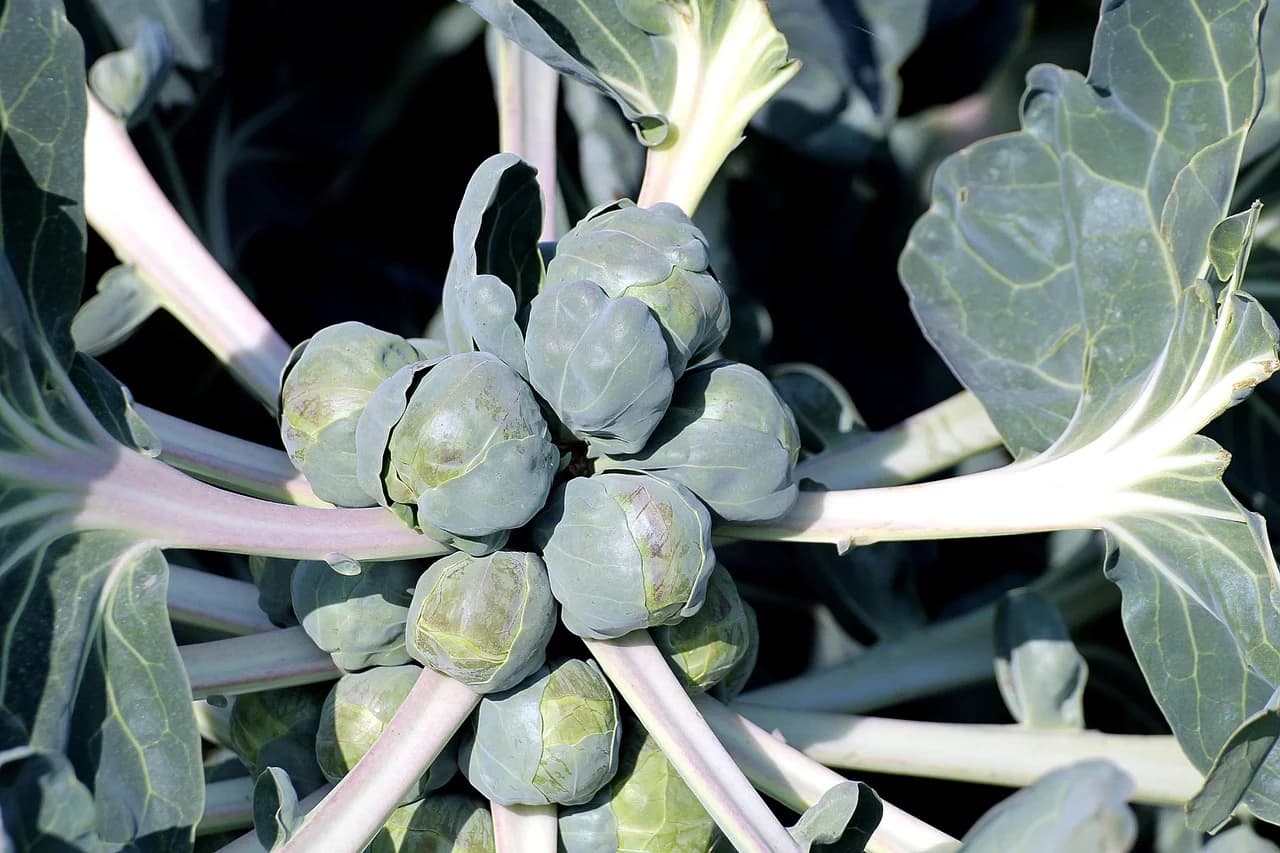
Brussels sprouts are cool-season plants grown for the small buds that form along a thick stalk. They belong to the cabbage family, and they are among the cole crops, which are cultivated forms of the species Brassica oleracea. The plants usually reach 2 to 4 feet (61 to 122 cm) tall and wide. The sprouts look like little cabbages and measure about 1 to 3 inches across.
The plants grow best in cool weather, between 60 and 70 °F (16 and 21 °C). Cool weather during maturity is also what gives the sprouts good flavor.
Growing details
- Start indoors
- Not yet verified
- Sow outdoors
- Not yet verified
- Water
- Not yet verified
- Containers
- Not yet verified
- Height
- 0.6–1.2 m2–4 ft
- Spread
- 0.6–1.2 m2–4 ft
- Frost tolerance
- Not yet verified
- Soil pH
- pH 6.0–7.0
- Life cycle
- Not yet verified
02 · How to grow
How to grow brussels sprouts from seed
Sowing indoors. Sow 2 to 3 seeds per cell about ¼ inch (6 mm) deep, and transplant the seedlings when they are ready at 4 to 6 weeks old. Start seed indoors 4 to 5 weeks before planting outdoors, as one Iowa guide describes for central Iowa, where transplants go out in early to mid-May.
Sowing outdoors. You can also sow directly in the garden about 4 months before the expected fall frost. Place 3 seeds every 18 inches (46 cm) at ¼ to ½ inch (0.6 to 1.3 cm) deep, then thin to one plant per spot. Many gardeners aim for a fall harvest, because the sprouts mature in cool weather.
Timing. Advice for gardeners in the Bay Area suggests setting transplants out in early August for short-season varieties of about 90 days, and earlier still for long-season varieties that can take up to 150 days.
Spacing and site. Space plants 18 to 24 inches (46 to 61 cm) apart in the row, with rows 30 to 36 inches (76 to 91 cm) apart. Give them at least 6 hours of direct sun each day, and ideally 8 to 10 hours. Choose a fertile, moist, well-drained soil with a pH between 6 and 7.
03 · Care
Caring for brussels sprouts
Watering. Brussels sprouts have shallow roots. If rain does not supply about 1 inch (2.5 cm) of water per week, they need weekly irrigation, and soaker hoses or drip lines are a good choice. Keep them well watered through the summer heat, since they need ample soil moisture.
Mulch and weeds. A 2 to 3 inch (5 to 8 cm) layer of mulch, such as straw or shredded leaves, helps control weeds and conserves soil moisture.
Feeding. Brussels sprouts need a lot of nutrients. Side-dress them 2 to 4 weeks after planting, or when the plants are 12 inches (30 cm) high. Get a soil test before planting and feed according to the results.
Topping. When the lower sprouts are ½ to ¾ inch (1.3 to 1.9 cm) across, remove the growing tip of the plant so the upper sprouts develop more evenly.
At a glance
How brussels sprouts compares with other vegetables
Worked out from the growing facts of the 79 seeds in Vegetables on SeedBattle.
- Brussels Sprouts
- Each of the other vegetables
- Their average
- Days to maturityTakes longer than average
85–110 days from transplanting
Average for vegetables: 72 days, from 14 other seeds
- Sowing depthShallower than average
6 mm–1.5 cm¼–½ in
Average for vegetables: 1 cm½ in, from 58 other seeds
- Spacing between plantsWider than average
46–61 cm1½–2 ft
Average for vegetables: 34 cm13 in, from 43 other seeds
- HeightAbout average
0.6–1.2 m2–4 ft
Average for vegetables: 93 cm3 ft, from 57 other seeds
04 · Problems
Common brussels sprouts problems
Cabbageworms, caterpillars, slugs, flea beetles and aphids can all feed on the plants. Leaf spots, black rot and blackleg are the listed diseases.
Cabbageworms are greenish caterpillars that chew large, irregular holes in the leaves. Treat them when first noticed with Bacillus thuringiensis (Bt). Flea beetles make small, round holes, and minor damage usually has little effect on yield.
Aphids are most likely in late fall or spring, when daytime temperatures are 65 to 80 °F (18 to 27 °C). Check the plants at least twice a week and knock or hose the aphids off. A forceful spray of water can help control them.
Plants that mature in hot, dry conditions may taste bitter or fail to form compact sprouts. An experienced Bay Area advisor reports that an unusual warm spell in winter can make the sprouts open early.
05 · Harvest
Harvesting brussels sprouts
Harvest when the sprouts are firm, compact, deep green and about 1 to 1½ inches (2.5 to 3.8 cm) across. Start with the lowest sprouts and twist or snap them off the stalk. One or more light frosts improve the flavor, so waiting for frosty weather is worth it. Harvest before the leaves turn yellow.
Opinions differ on the lower leaves. One guide says they can be removed to speed sprout development, while another says to leave them on, because they are needed for further growth.
06 · Storage
Storing brussels sprouts
For the best flavor, refrigerate sprouts for no more than a day or two, although they can keep 3 to 5 weeks. Placing them in a perforated plastic bag in the refrigerator also keeps them for 3 to 5 weeks. Blanched and frozen sprouts keep for up to one year.
Brussels Sprouts questions
How long do Brussels sprouts take to mature?
Plants are ready to harvest 85 to 110 days after transplanting, depending on the cultivar.
When should I plant Brussels sprouts?
Many gardeners aim for a fall harvest, since the sprouts mature in cool weather. Bay Area advice suggests setting transplants out in early August for short-season varieties of about 90 days.
How deep should I sow Brussels sprouts seeds?
Sow about ¼ inch (6 mm) deep when starting seed indoors. For direct sowing outdoors, use ¼ to ½ inch (0.6 to 1.3 cm) deep.
How far apart should I plant Brussels sprouts?
Space plants 18 to 24 inches (46 to 61 cm) apart in the row.
Quick answers
More brussels sprouts questions
Short answers taken from the growing facts on this page.
How much sun does brussels sprouts need?
Brussels sprouts grows in full sun.
How tall does brussels sprouts grow?
Brussels sprouts grows 0.6–1.2 m2–4 ft tall.
What soil pH does brussels sprouts need?
Aim for soil at pH 6.0–7.0.
Side by side
Compare brussels sprouts with…
Two seeds, every growing fact lined up, so you can pick the one that suits your space.
Vegetables
More seeds like brussels sprouts
Related seeds, plus others in the Vegetables category.
Find your next seed to grow
Browse all 223 seeds by sun, difficulty or pot size, or line brussels sprouts up against another seed.