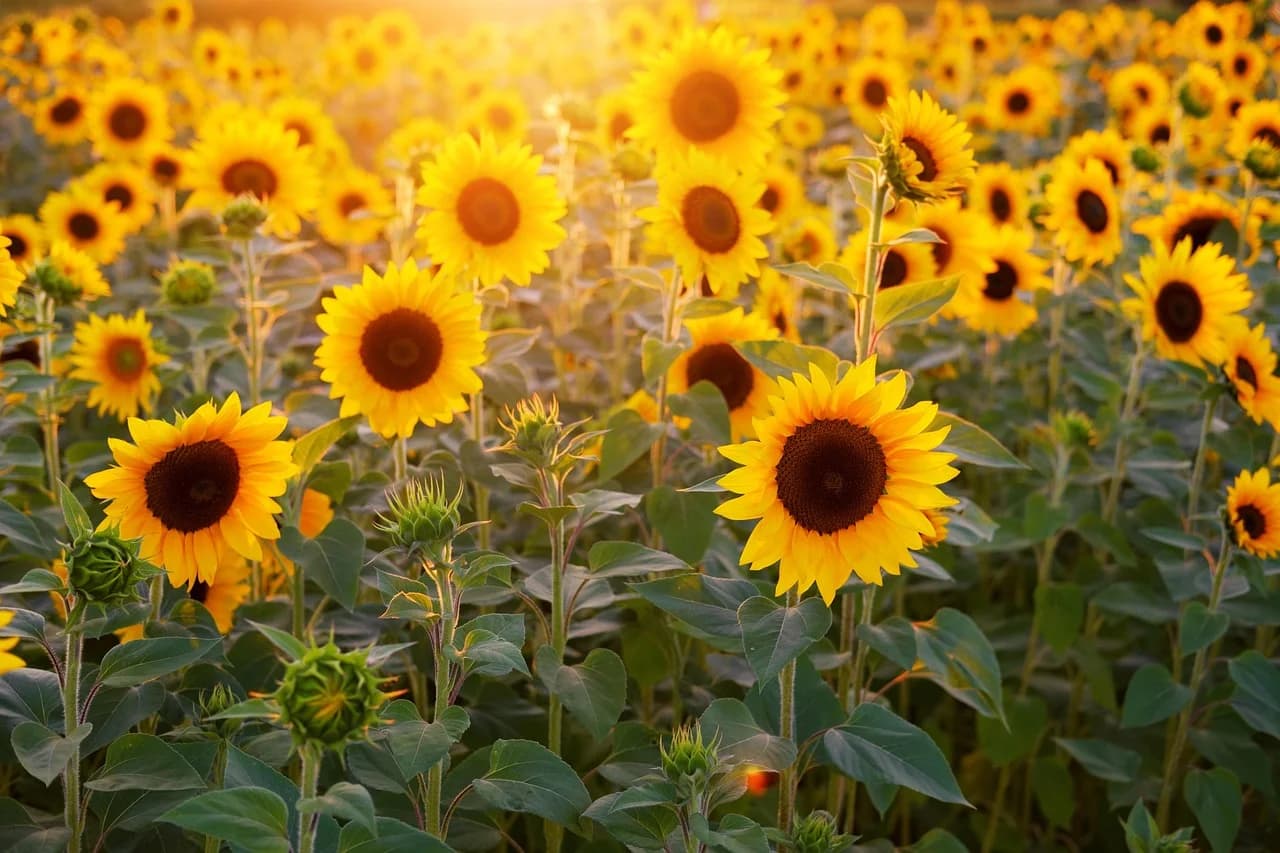
Sunflower
Helianthus annuus
A fast-growing summer annual you can sow straight into warm soil after the last frost. Pick dwarf types for pots or giants for height, and give them full sun.
Quick facts
- Germination time
- 7–14 days
- Germination temperature
- 21–24 °C70–75 °F
- Sowing depth
- 1.5 cm½ in
- Spacing between plants
- Not yet verified
- Days to maturity
- Not yet verified
- Sun
- Full sun
Safety for cats and dogs: not yet verified.
By SeedBattle EditorsUpdated
Spotted a mistake or missing detail? Improve this page
01 · Overview
About sunflower
Sunflowers (Helianthus annuus) are fast-growing, warm-season annuals with tall, upright stalks. Each plant goes from seed to seed in a single growing season. The species is native from the southwestern United States to Mexico.
There are sunflowers for almost any space, from dwarf types about 1 foot (30 cm) tall to giants that reach 10 feet (3 m) or more, with flowers in yellow, cream, orange, red and chocolate brown. They’re great for wildlife too: bees and other pollinators visit the flowers, and finches and small mammals eat the seeds.
Growing details
- Start indoors
- Not yet verified
- Sow outdoors
- Not yet verified
- Water
- Not yet verified
- Containers
- Yes
- Height
- Not yet verified
- Spread
- Not yet verified
- Frost tolerance
- Not yet verified
- Soil pH
- Not yet verified
- Life cycle
- Annual
02 · How to grow
How to grow sunflower from seed
Sow outdoors after the last frost. Sowing directly where the plants will grow is the recommended method. Wait until the danger of frost has passed and the soil is warmer than 50 °F (10 °C), then sow seeds ½ inch (1.3 cm) deep. They usually sprout in 7 to 14 days at 70–75 °F (21–24 °C).
Or give them a head start indoors. Starting seeds in pots indoors gives tall types a head start and keeps the seeds safe from mice and squirrels. Sunflowers dislike root disturbance, so sow only 2 to 3 weeks before you plan to plant them out. Harden the seedlings off, then plant them outside once the soil is warming up and there’s no risk of frost.
Choose a sunny spot with rich soil. Sunflowers love sun, and a spot with 6 to 8 hours of direct sunlight a day is ideal. They like well-drained soil improved with organic matter such as composted manure. Tall varieties do best somewhere sheltered from strong winds.
Spacing. Gardening experts suggest sowing seeds about 12 inches (30 cm) apart, but spacing depends on the variety, so follow your seed packet.
Pots. Dwarf sunflowers are perfect for patio containers. Plants in pots dry out quickly, so water whenever the compost feels dry, even daily in hot weather.
03 · Care
Caring for sunflower
Watering. Annual sunflowers are thirsty plants, and tall types in particular mustn’t be allowed to dry out. A layer of compost or other mulch after planting helps hold moisture in the soil; leave a gap around the stems.
Feeding. Branching and large-flowered types can be heavy feeders, so a regular slow-release fertilizer helps. Gardening experts suggest a potassium-rich tomato fertilizer to encourage flowering. Don’t overdo nitrogen: too much makes plants grow too vigorously, with oddly shaped flowers.
Support. Most annual sunflowers need support because they get top-heavy. Put a sturdy cane in at planting time and loosely tie the stem to it as the plant grows. Giants over 8 feet (2.4 m) are best planted next to a house wall and tied to it, while dwarf types 1–2 feet (30–60 cm) tall usually don’t need support.
Don’t pinch single-stem types. Pinched single-stem sunflowers give poor blooms or none at all.
At a glance
How sunflower compares with other flowers
Worked out from the growing facts of the 79 seeds in Flowers on SeedBattle.
- Sunflower
- Each of the other flowers
- Their average
- Germination timeSprouts sooner than average
7–14 days
Average for flowers: 12 days, from 42 other seeds
- Germination temperatureWarmer than average
21–24 °C70–75 °F
Average for flowers: 21 °C70 °F, from 40 other seeds
- Sowing depthDeeper than average
1.5 cm½ in
Average for flowers: 4 mm⅛ in, from 25 other seeds
04 · Problems
Common sunflower problems
Slugs and snails love young sunflowers, so plant out only strong, hardened-off seedlings or protect them. Seeds sown outdoors can be eaten by mice and squirrels before they sprout. Caterpillars and beetles may also chew the leaves.
Powdery mildew, leaf spots and rust can affect sunflowers, and sclerotinia may appear in wet summers. Overall, sunflowers have few insect problems. Left to self-seed, they can become weedy.
05 · Harvest
Harvesting sunflower
Cut flowers. Sunflowers can be cut when the color first shows, or later when they’re almost fully open, depending on how you’ll use them.
Seeds. Leave the flower head on the plant for at least two weeks. Once the petals have faded, cut the head off and leave it in a sunny, warm, dry place for another week. Then rub the head gently over a sheet of newspaper and the seeds will fall out. You can also leave the plants standing in autumn so finches can feed on the seeds; just collect a few for next year first.
06 · Storage
Storing sunflower
Keep saved seeds in an envelope or paper bag in a cool, dry, dark place until you sow them in spring.
07 · Safety
Sunflower safety
Sunflower leaves and stems can be rough and hairy and may aggravate skin allergies, so wear gloves when handling them. The seeds are eaten as a snack and used for cooking oil, the petals are edible, and young flower buds can be steamed like artichokes.
Sunflower questions
How long do sunflower seeds take to germinate?
Usually 7 to 14 days at 70–75 °F (21–24 °C).
When should I plant sunflower seeds?
Sow outdoors once the danger of frost has passed and the soil is warmer than 50 °F (10 °C). In the UK, gardening experts suggest sowing outdoors in mid-April and May, or indoors in pots from late March.
Can I grow sunflowers in a pot?
Yes, if you choose a dwarf variety: they’re perfect for patio containers. Water whenever the compost feels dry, which may be daily in hot weather.
Do sunflowers need staking?
Most annual sunflowers do, because their flowers make them top-heavy. Tie the stem loosely to a sturdy cane as it grows. Dwarf types 1–2 feet (30–60 cm) tall usually don’t need support.
How do I save sunflower seeds?
Leave the flower head on the plant for at least two weeks, then, once the petals have faded, cut it off and dry it somewhere warm and sunny for a week. Rub the head gently and the seeds will fall out. Store them somewhere cool, dry and dark until spring.
Quick answers
More sunflower questions
Short answers taken from the growing facts on this page.
How deep should I sow sunflower seeds?
Sow them 1.5 cm½ in deep.
What temperature do sunflower seeds need to sprout?
Sunflower seeds germinate at 21–24 °C70–75 °F.
Is sunflower an annual or a perennial?
Sunflower is an annual.
Side by side
Compare sunflower with…
Two seeds, every growing fact lined up, so you can pick the one that suits your space.
Flowers
More seeds like sunflower
Other seeds in the Flowers category.
Find your next seed to grow
Browse all 223 seeds by sun, difficulty or pot size, or line sunflower up against another seed.
