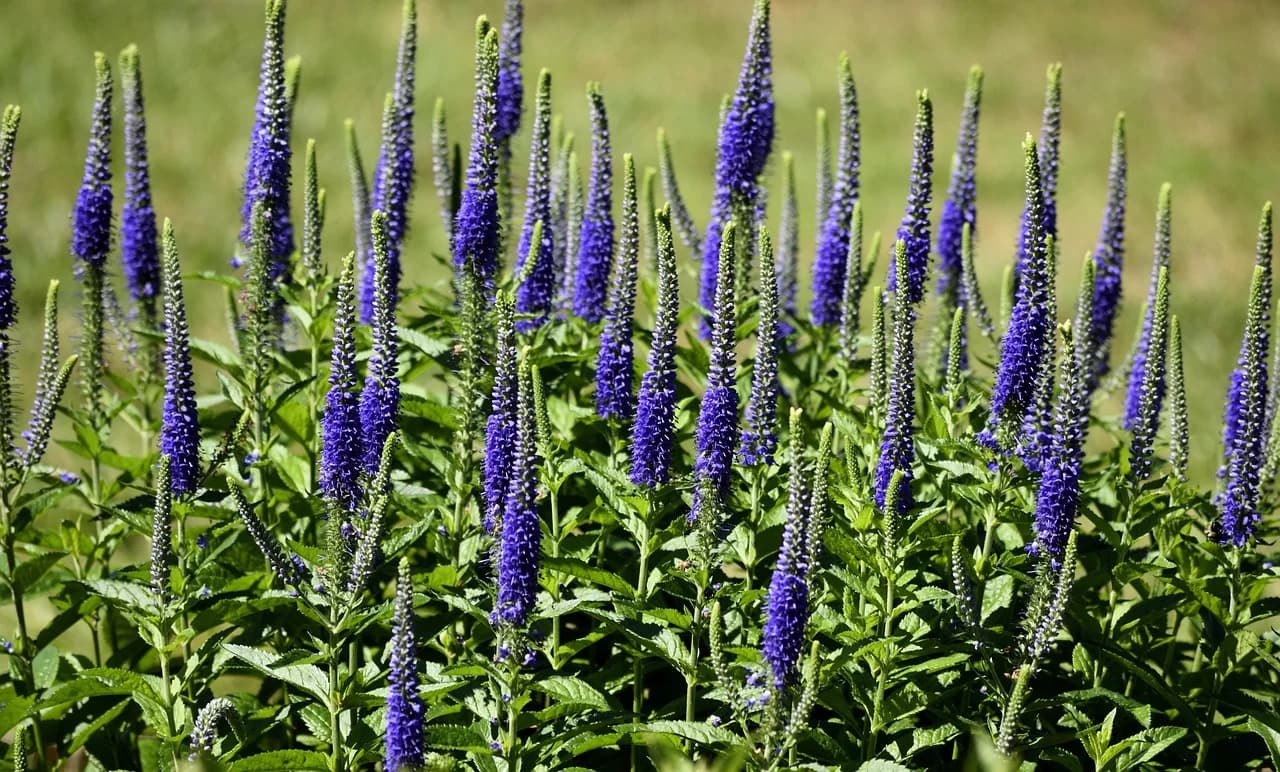
Spike Speedwell
Veronica spicata
Also called speedwell, veronica
Spike speedwell (Veronica spicata) is an easy perennial with spikes of small blue star-shaped flowers in summer. It needs full sun and well-drained soil, and is listed as hardy in USDA zones 3 to 8.
Quick facts
- Germination time
- Not yet verified
- Germination temperature
- Not yet verified
- Sowing depth
- Not yet verified
- Spacing between plants
- Not yet verified
- Days to maturity
- Not yet verified
- Sun
- Full sun
Safety for cats and dogs: not yet verified.
By SeedBattle EditorsReviewed by FahadUpdated
Spotted a mistake or missing detail? Improve this page
01 · Overview
About spike speedwell
Spike speedwell (Veronica spicata) is a herbaceous perennial that is easy to grow. It makes dense spikes of small, star-shaped blue flowers from late spring to mid-summer.
Flower colors include blue, pink and white. Cultivars such as ‘Icicle’ (white) and ‘Rosea’ (pink) are listed, and ‘Royal Candles’ is a compact, purple form.
Mature plants are about 2 to 3 feet tall (61 to 91 cm) and 2 to 2½ feet wide (61 to 76 cm). One gardening experts profile gives a taller range of 50 to 100 cm (about 1.6 to 3.3 feet). It is listed as hardy in USDA zones 3 to 8.
Its flowers attract bees and butterflies, and it is listed as resistant to deer and rabbits.
Growing details
- Start indoors
- Not yet verified
- Sow outdoors
- Not yet verified
- Water
- Not yet verified
- Containers
- Not yet verified
- Height
- 61–91 cm2–3 ft
- Spread
- 61–76 cm2–2½ ft
- Frost tolerance
- Hardy
- Soil pH
- Not yet verified
- Life cycle
- Perennial
- Hardiness zones
- USDA zones 3–8
02 · How to grow
How to grow spike speedwell from seed
These pages give no sowing date or sowing depth for spike speedwell. Gardening experts profile lists seed as a way to propagate it, but gives no timing.
Plant it in full sun, where it gets 6 or more hours of direct sunlight a day. It prefers loam with plenty of organic matter that stays moist but drains well. Gardening experts profile lists chalk, clay, loam and sand soils.
Allow about 12 inches to 3 feet (30 to 91 cm) of space for each plant.
03 · Care
Caring for spike speedwell
Deadheading and shearing. Remove spent flowers after blooming. Deadheading helps prolong the bloom period. When flowering is finished, cut the plant back to its basal rosette for repeat blooms in fall.
Drainage and division. Good drainage matters, especially over winter. Divide the clumps often to keep the plant vigorous.
At a glance
How spike speedwell compares with other flowers
Worked out from the growing facts of the 79 seeds in Flowers on SeedBattle.
- Spike Speedwell
- Each of the other flowers
- Their average
- HeightAbout average
61–91 cm2–3 ft
Average for flowers: 70 cm2½ ft, from 68 other seeds
04 · Problems
Common spike speedwell problems
Root rot can develop when soil stays too wet, especially in winter. Aphids may be a pest. The plant may also be prone to downy mildew, fungal leaf spot, fungal rot, Phytophthora and honey fungus.
05 · Harvest
Harvesting spike speedwell
The flowers are good for cutting and last a long time.
Spike Speedwell questions
Is spike speedwell a perennial?
Yes. It is a herbaceous perennial.
How much sun does spike speedwell need?
It grows in full sun, which means 6 or more hours of direct sunlight a day.
How tall does spike speedwell grow?
Plants are about 2 to 3 feet (61 to 91 cm) tall and 2 to 2½ feet (61 to 76 cm) wide. One gardening experts profile gives 50 to 100 cm (about 1.6 to 3.3 feet) tall.
Will spike speedwell survive cold winters?
It is listed as hardy in USDA zones 3 to 8. Gardening experts profile gives it a hardiness rating of H4.
Quick answers
More spike speedwell questions
Short answers taken from the growing facts on this page.
Which USDA zones can spike speedwell grow in?
Spike speedwell is hardy in USDA zones 3–8.
Side by side
Compare spike speedwell with…
Two seeds, every growing fact lined up, so you can pick the one that suits your space.
Flowers
More seeds like spike speedwell
Other seeds in the Flowers category.
Find your next seed to grow
Browse all 223 seeds by sun, difficulty or pot size, or line spike speedwell up against another seed.
