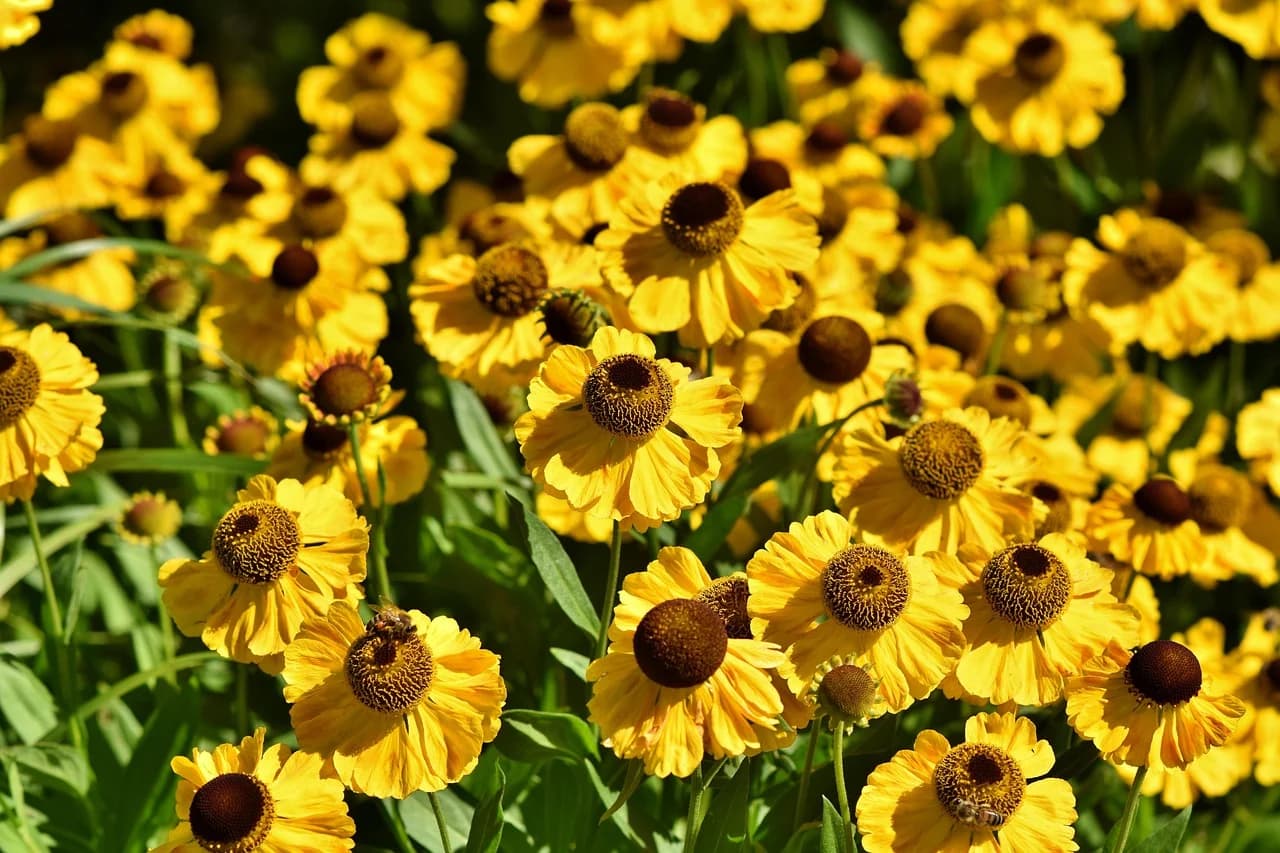
Sneezeweed
Helenium autumnale
Also called helenium
Sneezeweed (Helenium autumnale) is a hardy North American perennial with yellow to red daisy-like flowers in late summer and fall. It grows in full sun to partial shade and is easy to grow from seed or division.
Quick facts
- Germination time
- Not yet verified
- Germination temperature
- Not yet verified
- Sowing depth
- Not yet verified
- Spacing between plants
- Not yet verified
- Days to maturity
- Not yet verified
- Sun
- Full sun, partial shade
Safety for cats and dogs: not yet verified.
By SeedBattle EditorsUpdated
Spotted a mistake or missing detail? Improve this page
01 · Overview
About sneezeweed
Sneezeweed (Helenium autumnale) is a herbaceous perennial in the daisy family that is native to much of the United States and southern Canada. It grows 3 to 5 feet (91 to 152 cm) tall and 2 to 3 feet (61 to 91 cm) wide. Its flowers have yellow rays around a domed center from late summer into fall. Named cultivars such as Moerheim Beauty and Butterpat offer red, copper and yellow shades.
Growing details
- Start indoors
- Not yet verified
- Sow outdoors
- Not yet verified
- Water
- Not yet verified
- Containers
- Not yet verified
- Height
- 0.9–1.5 m3–5 ft
- Spread
- 61–91 cm2–3 ft
- Frost tolerance
- Hardy
- Soil pH
- Not yet verified
- Life cycle
- Perennial
- Hardiness zones
- USDA zones 3–8
02 · How to grow
How to grow sneezeweed from seed
Seed can be sown in spring. The species is easily grown from seed, but named hybrids are usually raised by division or tip cuttings made in early spring. Plant in full sun in average to rich soil that stays moist. Division can be done in autumn or spring, and the clumps can be divided every 2 to 3 years; another guide suggests every 3 to 5 years.
03 · Care
Caring for sneezeweed
Cut the plant back in early summer to encourage branching and more flowers. Taller types may need staking. Plants need watering during dry periods, and too much fertilizer promotes leafy growth and fewer flowers. Deadheading prolongs flowering.
At a glance
How sneezeweed compares with other flowers
Worked out from the growing facts of the 79 seeds in Flowers on SeedBattle.
- Sneezeweed
- Each of the other flowers
- Their average
- HeightTaller than average
0.9–1.5 m3–5 ft
Average for flowers: 69 cm2½ ft, from 68 other seeds
04 · Problems
Common sneezeweed problems
The plant is generally pest-free and disease-free, but it may be susceptible to leaf spot. Watch for powdery mildew, leaf spot and rust. Taller types can end up with ragged foliage if they dry out too much.
05 · Harvest
Harvesting sneezeweed
The flowers are excellent for cutting. They bloom into autumn and provide pollen and nectar for bees and other insects.
06 · Safety
Sneezeweed safety
The page lists the flowers, leaves and seeds as poisonous to people, with medium severity, and says it is toxic only if eaten in large quantities. Keep people from eating these parts. Handling the foliage can cause skin irritation in susceptible people.
Sneezeweed questions
Is sneezeweed a perennial or an annual?
Sneezeweed is a herbaceous perennial that comes back year after year.
How tall does sneezeweed grow?
It grows 3 to 5 feet (91 to 152 cm) tall and 2 to 3 feet (61 to 91 cm) wide. Taller cultivars can reach 4 feet or more.
When does sneezeweed bloom?
Most flowering happens in late summer to autumn, sometimes until the first frost.
Is sneezeweed poisonous?
The page says it is poisonous to people, with medium severity, and toxic only if eaten in large quantities.
Should I grow sneezeweed from seed or division?
The species is easily grown from seed, but hybrid varieties are usually propagated by division or tip cuttings in early spring.
Quick answers
More sneezeweed questions
Short answers taken from the growing facts on this page.
How much sun does sneezeweed need?
Sneezeweed grows in full sun or partial shade.
Can sneezeweed survive frost?
Yes. Sneezeweed is hardy.
Which USDA zones can sneezeweed grow in?
Sneezeweed is hardy in USDA zones 3–8.
Side by side
Compare sneezeweed with…
Two seeds, every growing fact lined up, so you can pick the one that suits your space.
Flowers
More seeds like sneezeweed
Other seeds in the Flowers category.
Find your next seed to grow
Browse all 223 seeds by sun, difficulty or pot size, or line sneezeweed up against another seed.
