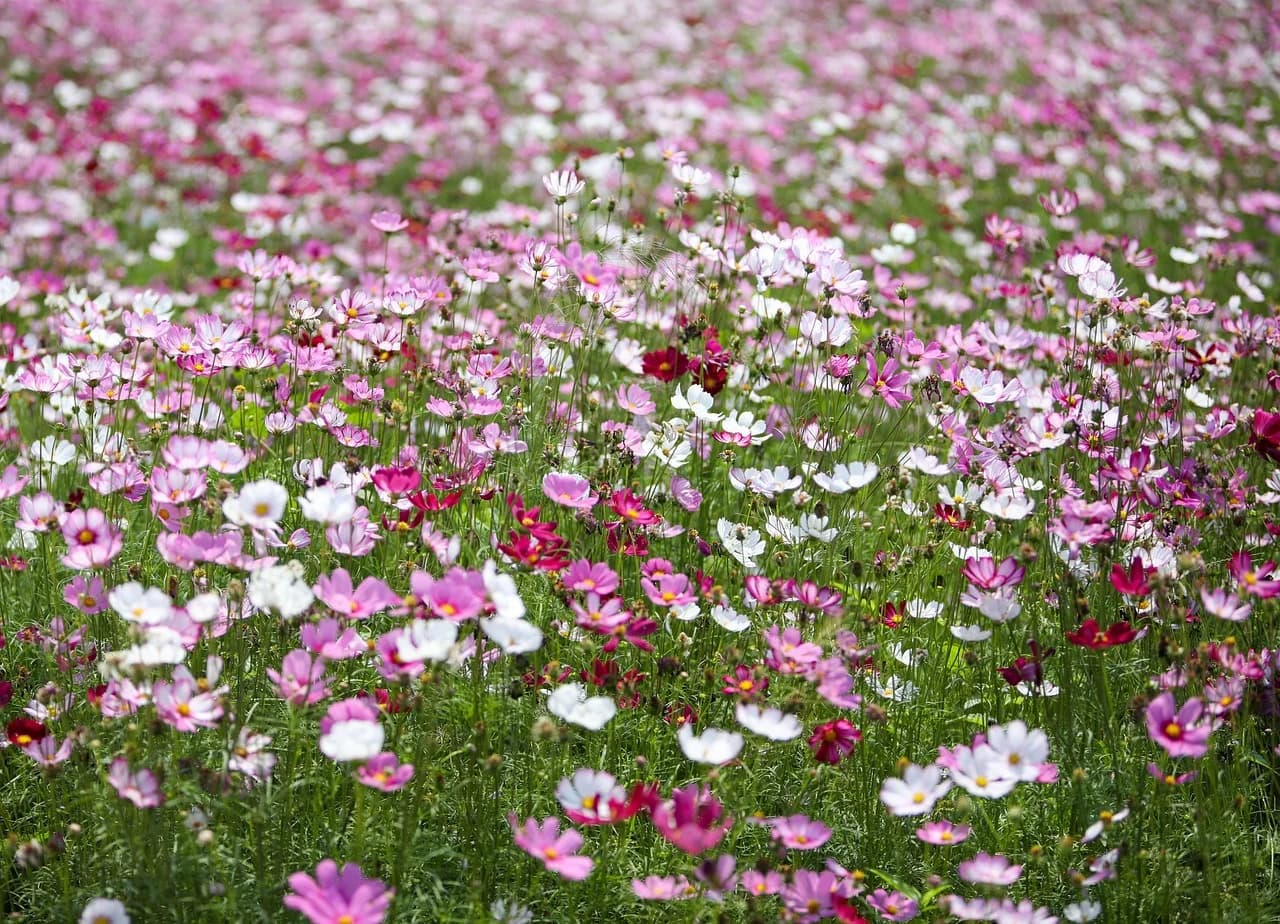
Cosmos
Cosmos bipinnatus
A tall, easy annual with daisy-like flowers for borders and cutting. Sow it in warm soil after the last frost, in full sun, and skip the fertilizer.
Quick facts
- Germination time
- 7–21 days
- Germination temperature
- Not yet verified
- Sowing depth
- 3 mm⅛ in
- Spacing between plants
- Not yet verified
- Days to maturity
- Not yet verified
- Sun
- Full sun
Safety for cats and dogs: not yet verified.
By SeedBattle EditorsUpdated
Spotted a mistake or missing detail? Improve this page
01 · Overview
About cosmos
Cosmos (Cosmos bipinnatus) is a tall annual from Mexico with daisy-like flowers in maroon, pink, lavender and white on stalks that can reach 4 feet (1.2 m). Its leaves are deeply cut and lacy.
Annual cosmos is easy to grow from seed, looks best planted in groups, and gives you flowers for cutting over several months. It needs only basic care to bloom all summer, and it does better without rich soil or fertilizer.
Growing details
- Start indoors
- Not yet verified
- Sow outdoors
- Not yet verified
- Water
- Not yet verified
- Containers
- Yes
- Height
- Not yet verified
- Spread
- Not yet verified
- Frost tolerance
- Not yet verified
- Soil pH
- Not yet verified
- Life cycle
- Annual
02 · How to grow
How to grow cosmos from seed
Sow outdoors after frost. Sow seeds outdoors once the danger of frost has passed and the soil has warmed to at least 65 °F (18 °C). Scatter them on the surface and rake them in lightly, about ⅛ inch (3 mm) deep, because seeds planted deeper germinate poorly. Keep the soil moist after sowing. Seedlings appear in 7 to 21 days, and germination is best at soil temperatures of 70–75 °F (21–24 °C).
Or start indoors. You can also sow in plug trays 5 to 7 weeks before planting out, covering the seeds lightly. At 68–72 °F (20–22 °C) they come up in 7 to 10 days. Harden the seedlings off and plant them out after the danger of frost has passed.
Sun. Cosmos likes full sun, at least 8 hours a day, and won’t flower in shade.
Soil. Cosmos grows in most ordinary garden soils as long as they aren’t soggy in summer, though very dry, poor soils and heavy, wet soils don’t suit it. Gardening experts recommend well-drained soil of average to poor fertility and warns that nutrient-rich soil gives floppy stems, late flowers and fewer blooms.
Spacing. Gardening experts space plants 9–12 inches (23–30 cm) apart and notes that wider spacing gives stronger stems. Gardening experts recommend 1–2 feet (30–60 cm), adding that plants set closer together hold each other up.
Pots. Cosmos can be grown in containers as well as beds.
03 · Care
Caring for cosmos
Watering. Once seedlings are up, water deeply about once a week. Cosmos does well in the drier parts of the garden, and overwatering reduces flowering.
Feeding. Don’t fertilize cosmos.
Pinching and deadheading. Pinching young plants encourages branching. Deadheading keeps the flowers coming all summer and reduces self-sown seedlings. If plants start to flag, trim them back to 12–18 inches (30–46 cm) and they’ll be flowering again in about a month.
Support. Tall varieties may need staking in places with strong winds and frequent storms.
Day length. Cosmos responds to day length and flowers best in late summer, as the days get shorter.
At a glance
How cosmos compares with other flowers
Worked out from the growing facts of the 79 seeds in Flowers on SeedBattle.
- Cosmos
- Each of the other flowers
- Their average
- Germination timeSlower to sprout than average
7–21 days
Average for flowers: 12 days, from 42 other seeds
- Sowing depthAbout average
3 mm⅛ in
Average for flowers: 4 mm⅛ in, from 25 other seeds
04 · Problems
Common cosmos problems
Few insects and diseases affect cosmos. Pests to watch for include aphids, aster leafhoppers and the gray looper moth, and the most common diseases are stem canker, powdery mildew and gray mold. Slugs can also be a problem.
The biggest issue is often self-seeding: cosmos produces so much seed that it’s sometimes called a weed. Plant it where you’re happy for it to come back, and deadhead to reduce seeding. If you do want it to self-seed, leave a few seedheads to ripen.
05 · Harvest
Harvesting cosmos
For cut flowers, gardening experts suggest cutting when the petals are just opening but not yet flat, while gardening experts suggest cutting stems of flowers in full bloom. You can keep harvesting all season, and the flowers can be used fresh or dried.
06 · Storage
Storing cosmos
Seeds. Dry the flowers completely, remove the seeds from the heads, and keep them in a paper bag somewhere cool and dry. Because cosmos reseeds itself so readily, you may not need to save seed at all.
Dried flowers. Dry blooms in a well-ventilated spot out of the sun, or in a food dryer; they should be dry in 1 to 5 days. Store them in a moisture-tight container somewhere cool and dark.
Cosmos questions
How long do cosmos seeds take to germinate?
Anywhere from 7 to 21 days. At 68–72 °F (20–22 °C) they often come up in 7 to 10 days.
When should I plant cosmos seeds?
Sow outdoors once the danger of frost has passed and the soil has warmed to at least 65 °F (18 °C).
Should I fertilize cosmos?
No. Gardening experts advise against fertilizing cosmos: nutrient-rich soil gives weak, floppy stems, late flowers and fewer blooms.
Does cosmos come back every year?
Cosmos is an annual, so each plant lives for one season, but it reseeds itself readily.
Why is my cosmos not flowering?
Common causes are too much shade, since cosmos won’t flower in shade, and soil that’s too rich or watered too much, both of which reduce flowering. Cosmos also flowers best in late summer, when the days get shorter.
Quick answers
More cosmos questions
Short answers taken from the growing facts on this page.
How deep should I sow cosmos seeds?
Sow them 3 mm⅛ in deep.
How much sun does cosmos need?
Cosmos grows in full sun.
Can I grow cosmos in a pot?
Yes, cosmos grows in containers.
Side by side
Compare cosmos with…
Two seeds, every growing fact lined up, so you can pick the one that suits your space.

Flowers
More seeds like cosmos
Other seeds in the Flowers category.
Find your next seed to grow
Browse all 223 seeds by sun, difficulty or pot size, or line cosmos up against another seed.
