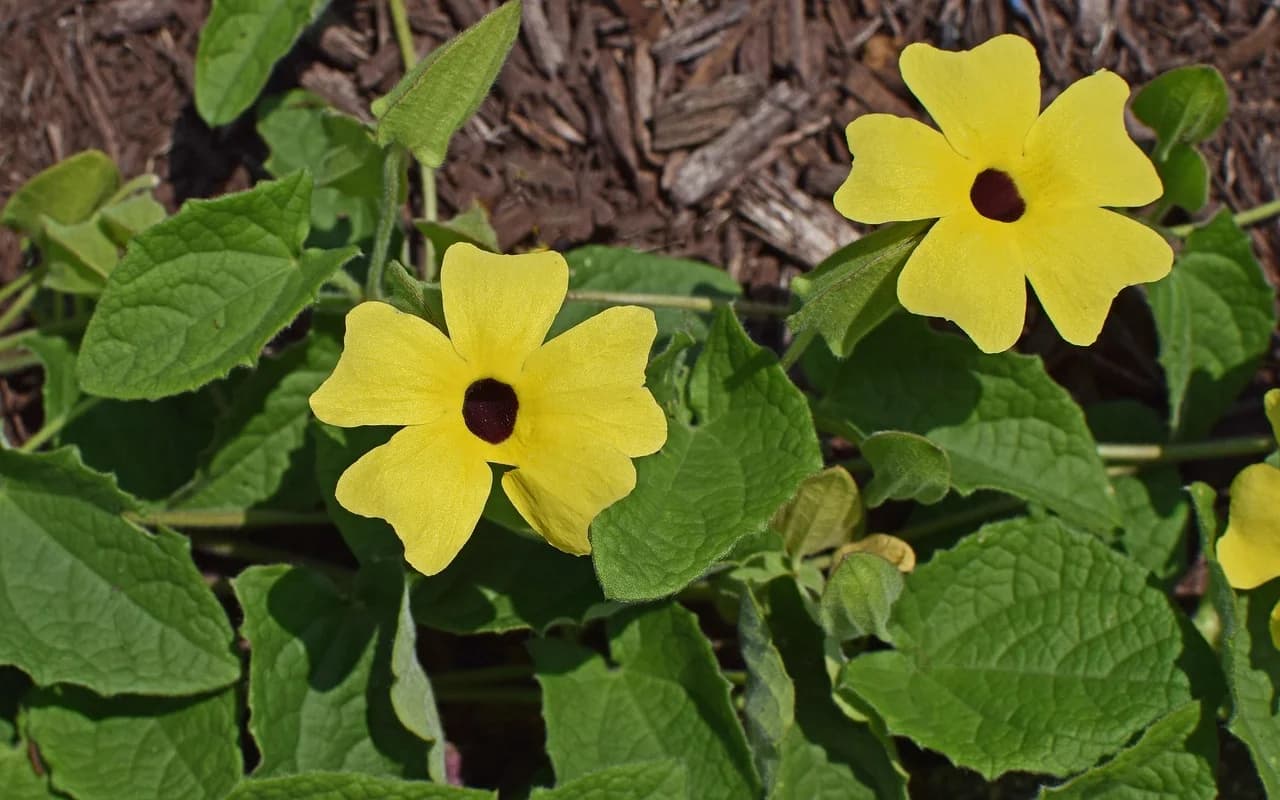
Black-Eyed Susan Vine
Thunbergia alata
Also called thunbergia
Black-eyed Susan vine is a fast-growing twining climber with orange or yellow flowers, usually grown as an annual from seed in full sun with a support to climb on.
Quick facts
- Germination time
- 10–21 days
- Germination temperature
- Not yet verified
- Sowing depth
- Not yet verified
- Spacing between plants
- 36–41 cm14–16 in
- Days to maturity
- Not yet verified
- Sun
- Full sun, partial shade
Safety for cats and dogs: not yet verified.
By SeedBattle EditorsUpdated
Spotted a mistake or missing detail? Improve this page
01 · Overview
About black-eyed susan vine
Black-eyed Susan vine is a twining tropical climber with orange or yellow trumpet-shaped flowers that have dark centers, native to tropical Africa. Its soft, hairy, heart-shaped to triangular leaves grow up to 3 inches (8 cm) long. Despite the shared name, it is not related to the black-eyed Susan, Rudbeckia hirta. It is usually grown as an annual, and it blooms from mid-summer until frost.
Growing details
- Start indoors
- 6–8 weeks before the last frost
- Sow outdoors
- Not yet verified
- Water
- Moderate
- Containers
- Yes
- Height
- 0.9–2.4 m3–8 ft
- Spread
- 0.9–1.8 m3–6 ft
- Frost tolerance
- Tender (no frost)
- Soil pH
- Not yet verified
- Life cycle
- Not yet verified
Sowing timeline
When to sow black-eyed susan vine seeds
Counted from your area's average last spring frost date. Find yours from a local weather service or garden center, then count back or forward.
- Germination time
- 10–21 days
- Frost tolerance
- Tender (no frost)
02 · How to grow
How to grow black-eyed susan vine from seed
Sowing. Start seeds indoors 6 to 8 weeks before the average last spring frost. Soaking the seeds in warm water overnight before sowing speeds up germination. Press the seeds into the soil so they are fully covered. Seeds usually sprout in 10 to 21 days.
Planting outdoors. Move plants outside once all danger of frost has passed and night temperatures stay above 50 °F (10 °C). Direct sowing is possible once the soil reaches 60 °F (16 °C) in spring, but transplants do better in short seasons such as the upper Midwest. Space plants 14 to 16 inches (36 to 41 cm) apart beside a trellis, fence or other support. Choose a well-drained spot in full sun and provide a support for it to climb.
Other ways to propagate. It can also be grown from stem cuttings, though seed-grown plants tend to be more vigorous.
Varieties. Cultivars differ in flower color, so ‘Bright Eyes’ has all-white flowers and ‘Suzie Orange’ has bright orange flowers. Vine length also varies between cultivars.
03 · Care
Caring for black-eyed susan vine
Light and water. Give it full sun with some afternoon shade. It does best in rich soil that holds moderate moisture but drains well.
Support and feeding. It twines, so it does best on a trellis, fence, arbor or tall support, though it can also trail from a hanging basket. Container plants can be fed every 2 to 3 weeks while they are in bloom.
Overwintering. Plants in containers can be moved indoors to a warm, very bright room. They may keep blooming over winter if they sit in a sunny spot and night temperatures stay above 60 °F (16 °C).
At a glance
How black-eyed susan vine compares with other flowers
Worked out from the growing facts of the 79 seeds in Flowers on SeedBattle.
- Black-Eyed Susan Vine
- Each of the other flowers
- Their average
- Germination timeSlower to sprout than average
10–21 days
Average for flowers: 12 days, from 42 other seeds
- Spacing between plantsAbout average
36–41 cm14–16 in
Average for flowers: 36 cm14 in, from 13 other seeds
- HeightTaller than average
0.9–2.4 m3–8 ft
Average for flowers: 69 cm2½ ft, from 68 other seeds
04 · Problems
Common black-eyed susan vine problems
Outdoors, black-eyed Susan vine has no serious problems. Indoors, spider mites, scale and whiteflies are the usual pests, and aphids can also be a problem. Plants may be susceptible to powdery mildew.
Weedy growth. It reseeds easily in frost-free areas and can become weedy. It has become invasive in many warm regions around the world, so grow it with caution where frost is absent.
Black-Eyed Susan Vine questions
How long do black-eyed Susan vine seeds take to germinate?
Seeds should sprout in 10 to 21 days. Soaking them in warm water overnight before sowing can speed this up.
When should I start black-eyed Susan vine seeds indoors?
Start them indoors 6 to 8 weeks before the average last spring frost.
Can I grow black-eyed Susan vine in a pot?
It can be grown in a large container with a small trellis. Container plants can also be moved indoors for winter.
Does black-eyed Susan vine need something to climb?
Yes, it is a twining vine and does best on a trellis, fence or arbor.
Quick answers
More black-eyed susan vine questions
Short answers taken from the growing facts on this page.
How far apart should I plant black-eyed susan vine?
Space the plants 36–41 cm14–16 in apart.
How much sun does black-eyed susan vine need?
Black-eyed susan vine grows in full sun or partial shade.
How tall does black-eyed susan vine grow?
Black-eyed susan vine grows 0.9–2.4 m3–8 ft tall.
Can black-eyed susan vine survive frost?
No. Black-eyed susan vine is tender, so it can't take frost.
How much water does black-eyed susan vine need?
Black-eyed susan vine has moderate water needs.
Side by side
Compare black-eyed susan vine with…
Two seeds, every growing fact lined up, so you can pick the one that suits your space.

Flowers
More seeds like black-eyed susan vine
Other seeds in the Flowers category.
Find your next seed to grow
Browse all 223 seeds by sun, difficulty or pot size, or line black-eyed susan vine up against another seed.